42 objects on this chartobjets sur cette carteobjetos en esta cartaObjekte auf dieser Karte
Easiest firstLes plus faciles d'abordLos más fáciles primeroDie einfachsten zuerst
What this chart shows, in the order you should try: start where success is certain, work toward the hard ones.Ce que montre cette carte, dans l'ordre où l'essayer : commencez là où le succès est certain, avancez vers le difficile.Lo que muestra esta carta, en el orden en que conviene intentarlo: empiece donde el éxito es seguro y avance hacia lo difícil.Was diese Karte zeigt, in der Reihenfolge, in der man es versuchen sollte: Beginnen Sie, wo der Erfolg sicher ist, und arbeiten Sie sich vor.
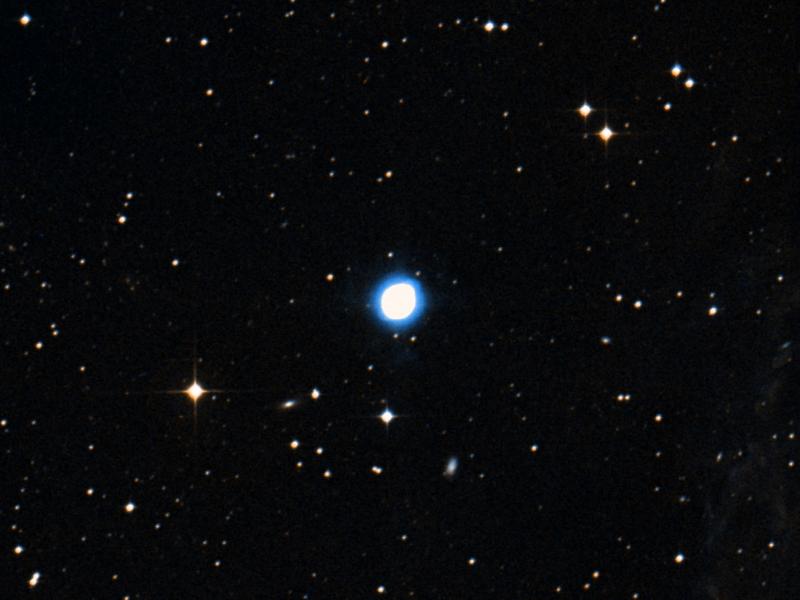
NGC 3242
small telescopepetit télescopetelescopio pequeñokleines Teleskop
Surface brightnessBrillance de surfaceBrillo superficialFlächenhelligkeit
14.4 mag/arcsec²
DistanceDistanceDistanciaEntfernung
about 1 400 light-yearsenviron 1 400 années-lumièreunos 1 400 años luzetwa 1 400 Lichtjahre
The Ghost of Jupiter: a planetary the apparent size of the planet, and the brightest of the spring sky — an intense blue-green disc at any power, an inner lens within an outer shell at 250 mm. In Hydra's long emptiness it looks almost artificial.Le Fantôme de Jupiter : une planétaire de la taille apparente de la planète, la plus brillante du ciel de printemps — un disque bleu-vert intense à tout grossissement, une lentille interne dans une coquille externe à 250 mm. Dans le long vide de l'Hydre, elle paraît presque artificielle.El Fantasma de Júpiter: una planetaria del tamaño aparente del planeta, la más brillante del cielo de primavera — un disco azul verdoso intenso a cualquier aumento, una lente interna dentro de una capa externa a 250 mm. En el largo vacío de la Hidra parece casi artificial.Jupiters Geist: ein Planetarischer von der scheinbaren Größe des Planeten, der hellste des Frühlingshimmels — eine intensiv blaugrüne Scheibe bei jeder Vergrößerung, eine innere Linse in äußerer Hülle bei 250 mm. In der langen Leere der Wasserschlange wirkt er fast künstlich.
small telescopepetit télescopetelescopio pequeñokleines TeleskopDSS2 — STScI/NASA · CDS
TypeTypeTipoTyp
galaxygalaxiegalaxiaGalaxie
ConstellationConstellationConstelaciónSternbild
Leo
MagnitudeMagnitudeMagnitudHelligkeit
8.9
SizeTailleTamañoGröße
10.28′ × 4.61′
Surface brightnessBrillance de surfaceBrillo superficialFlächenhelligkeit
21.7 mag/arcsec²
DistanceDistanceDistanciaEntfernung
about 36 million light-yearsenviron 36 millions d'années-lumièreunos 36 millones de años luzetwa 36 Millionen Lichtjahre
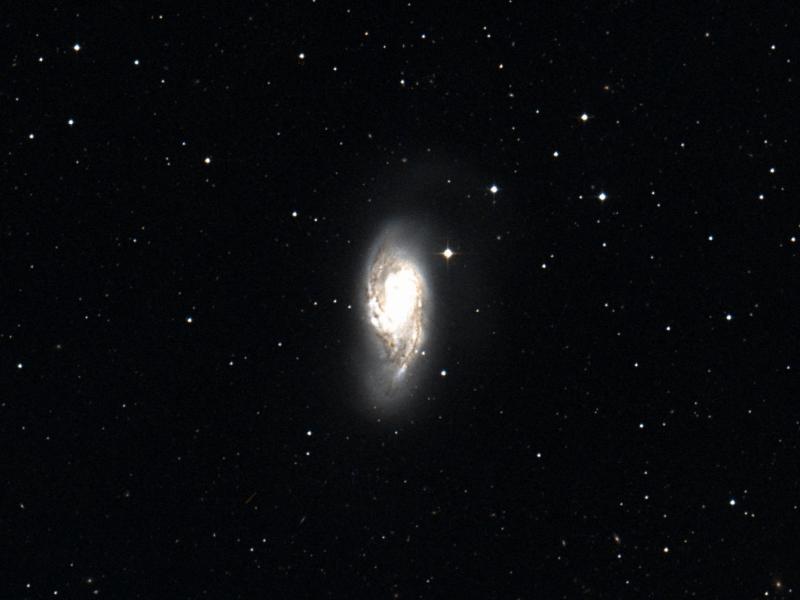
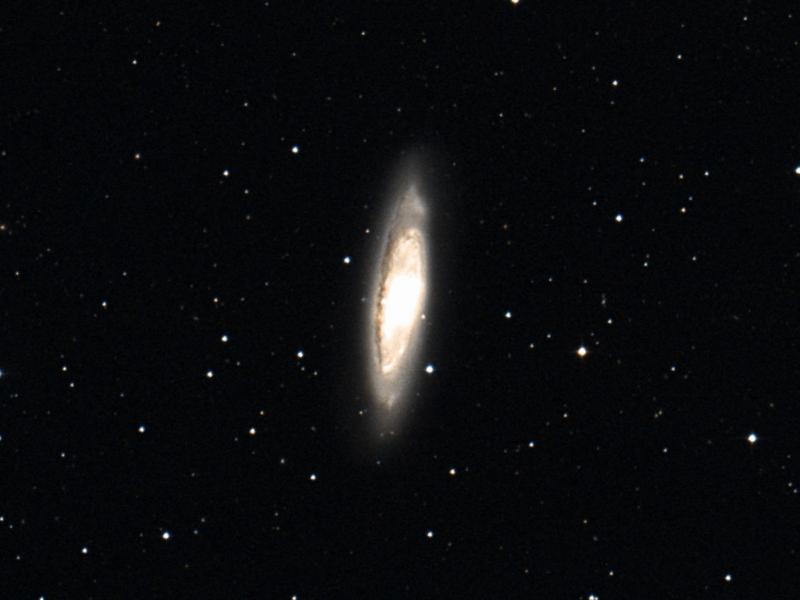
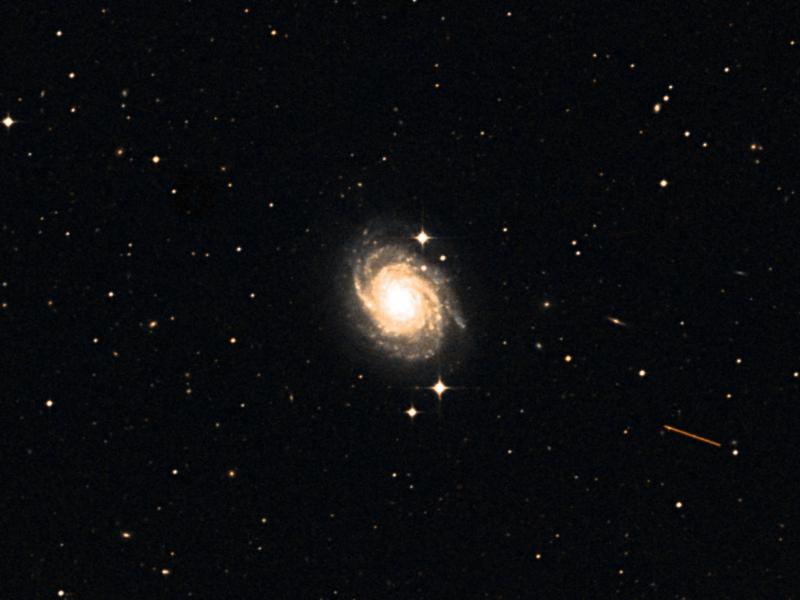
The brightest of the Leo Triplet, with a visibly asymmetric glow — its arms were bent by a close pass of NGC 3628. Any small telescope catches it; 250 mm show the brighter arm as a curved extension south of the core.La plus brillante du Triplet du Lion, à la lueur visiblement asymétrique — ses bras ont été tordus par un passage rapproché de NGC 3628. Tout petit télescope l'attrape ; 250 mm montrent le bras le plus brillant comme une extension courbe au sud du cœur.La más brillante del Triplete de Leo, con un resplandor visiblemente asimétrico — sus brazos fueron doblados por un paso cercano de NGC 3628. Cualquier telescopio pequeño la capta; 250 mm muestran el brazo más brillante como una extensión curva al sur del núcleo.Die hellste des Leo-Tripletts, mit sichtbar asymmetrischem Schein — ihre Arme wurden von einer nahen Passage von NGC 3628 verbogen. Jedes kleine Teleskop fängt sie; 250 mm zeigen den helleren Arm als gekrümmten Fortsatz südlich des Kerns.
small telescopepetit télescopetelescopio pequeñokleines TeleskopDSS2 — STScI/NASA · CDS
TypeTypeTipoTyp
galaxygalaxiegalaxiaGalaxie
ConstellationConstellationConstelaciónSternbild
Leo
MagnitudeMagnitudeMagnitudHelligkeit
9.1
SizeTailleTamañoGröße
8.32′ × 4.47′
Surface brightnessBrillance de surfaceBrillo superficialFlächenhelligkeit
21.7 mag/arcsec²
DistanceDistanceDistanciaEntfernung
about 26 million light-yearsenviron 26 millions d'années-lumièreunos 26 millones de años luzetwa 26 Millionen Lichtjahre
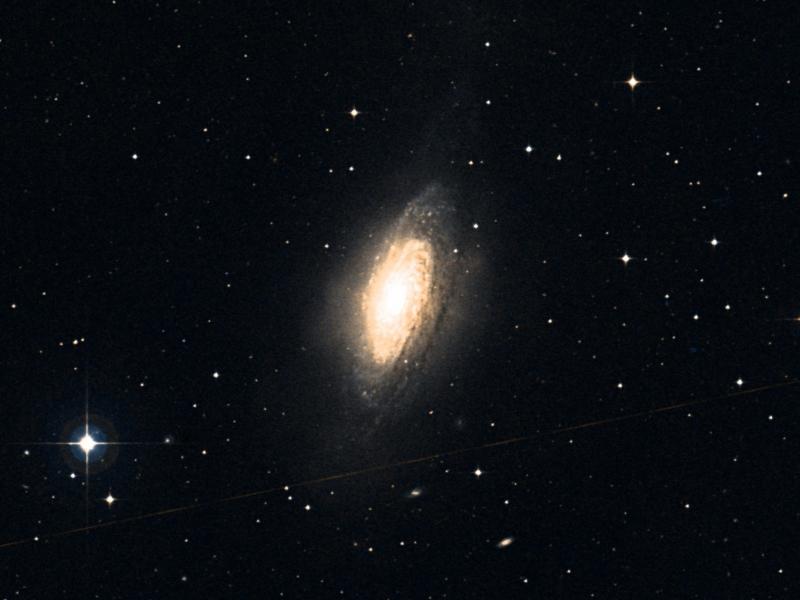
A bright flocculent spiral under the Lion's hindpaw, its disc built of woolly arm-fragments — in the eyepiece a strong oval with a grainy texture and a bright core, among the best galaxies nobody points at.Une spirale floconneuse brillante sous la patte arrière du Lion, son disque fait de fragments de bras laineux — à l'oculaire un ovale franc à la texture granuleuse et au cœur brillant, parmi les meilleures galaxies que personne ne pointe.Una espiral floculenta brillante bajo la pata trasera del León, con su disco hecho de fragmentos de brazo lanosos — en el ocular un óvalo firme de textura granulada y núcleo brillante, entre las mejores galaxias que nadie apunta.Eine helle, flockige Spirale unter der Hinterpfote des Löwen, ihre Scheibe aus wolligen Armfragmenten gebaut — im Okular ein kräftiges Oval mit körniger Textur und hellem Kern, unter den besten Galaxien, auf die niemand zielt.
small telescopepetit télescopetelescopio pequeñokleines TeleskopDSS2 — STScI/NASA · CDS
TypeTypeTipoTyp
galaxygalaxiegalaxiaGalaxie
ConstellationConstellationConstelaciónSternbild
Leo
MagnitudeMagnitudeMagnitudHelligkeit
9.2
SizeTailleTamañoGröße
8.26′ × 5.51′
Surface brightnessBrillance de surfaceBrillo superficialFlächenhelligkeit
22.0 mag/arcsec²
DistanceDistanceDistanciaEntfernung
about 31 million light-yearsenviron 31 millions d'années-lumièreunos 31 millones de años luzetwa 31 Millionen Lichtjahre
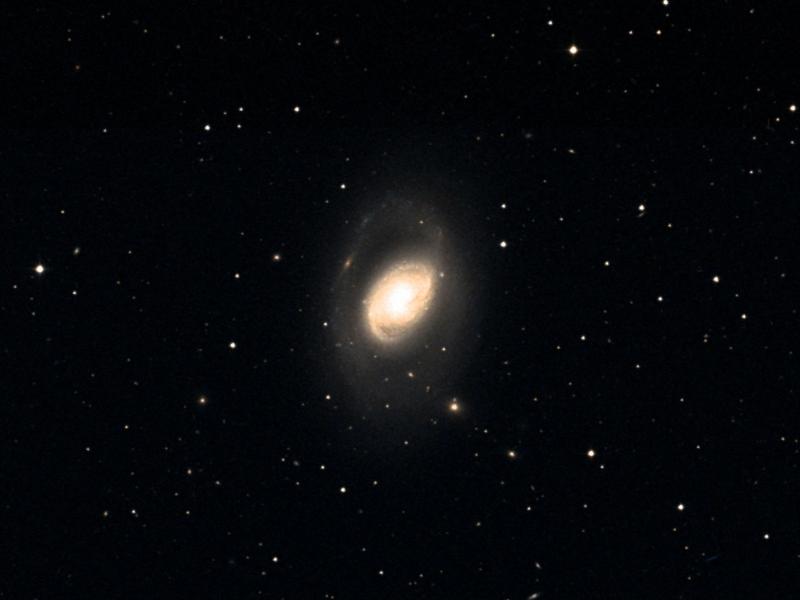
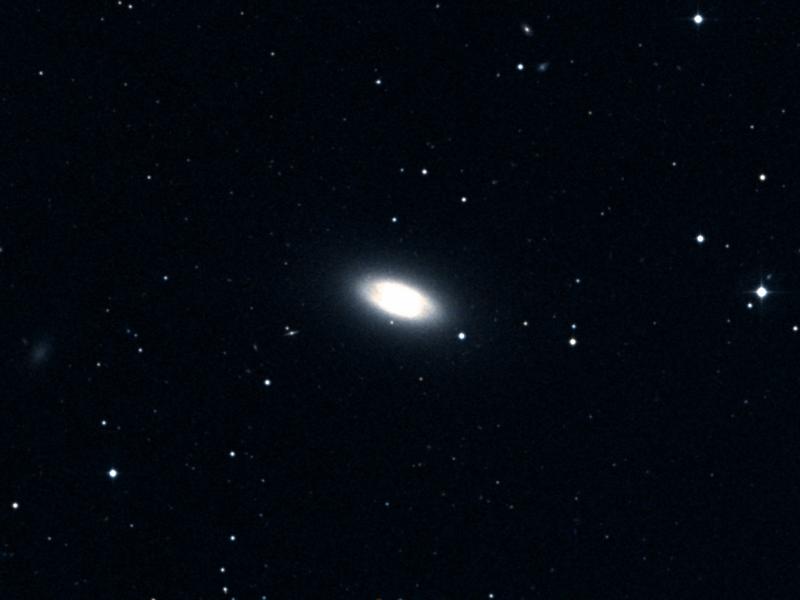
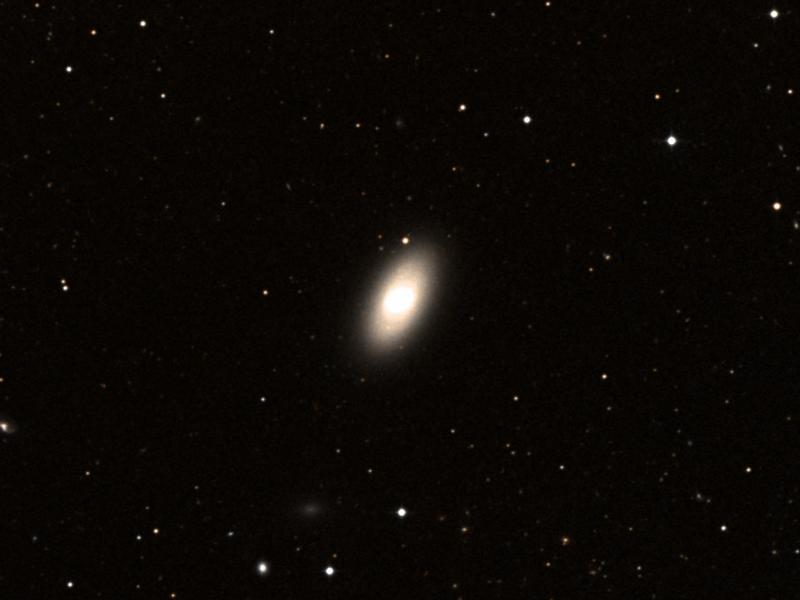
The brightest of the Leo I group, under the Lion's belly: an oval glow with an off-centre core that small telescopes show without struggle. Use it as the anchor for the M 95–M 96–M 105 triangle, one of spring's best single fields of galaxies.La plus brillante du groupe Leo I, sous le ventre du Lion : une lueur ovale au cœur décentré, que les petits télescopes montrent sans peine. Prenez-la comme ancre du triangle M 95–M 96–M 105, l'un des meilleurs champs de galaxies du printemps.La más brillante del grupo Leo I, bajo el vientre del León: un resplandor oval de núcleo descentrado que los telescopios pequeños muestran sin esfuerzo. Úsela como ancla del triángulo M 95–M 96–M 105, uno de los mejores campos de galaxias de la primavera.Die hellste der Leo-I-Gruppe, unter dem Bauch des Löwen: ein ovales Glimmen mit außermittigem Kern, das kleine Teleskope mühelos zeigen. Als Anker fürs Dreieck M 95–M 96–M 105 nehmen, eines der besten Galaxienfelder des Frühlings.
small telescopepetit télescopetelescopio pequeñokleines TeleskopDSS2 — STScI/NASA · CDS
TypeTypeTipoTyp
galaxygalaxiegalaxiaGalaxie
ConstellationConstellationConstelaciónSternbild
Leo
MagnitudeMagnitudeMagnitudHelligkeit
9.3
SizeTailleTamañoGröße
4.89′ × 4.25′
Surface brightnessBrillance de surfaceBrillo superficialFlächenhelligkeit
21.2 mag/arcsec²
DistanceDistanceDistanciaEntfernung
about 32 million light-yearsenviron 32 millions d'années-lumièreunos 32 millones de años luzetwa 32 Millionen Lichtjahre
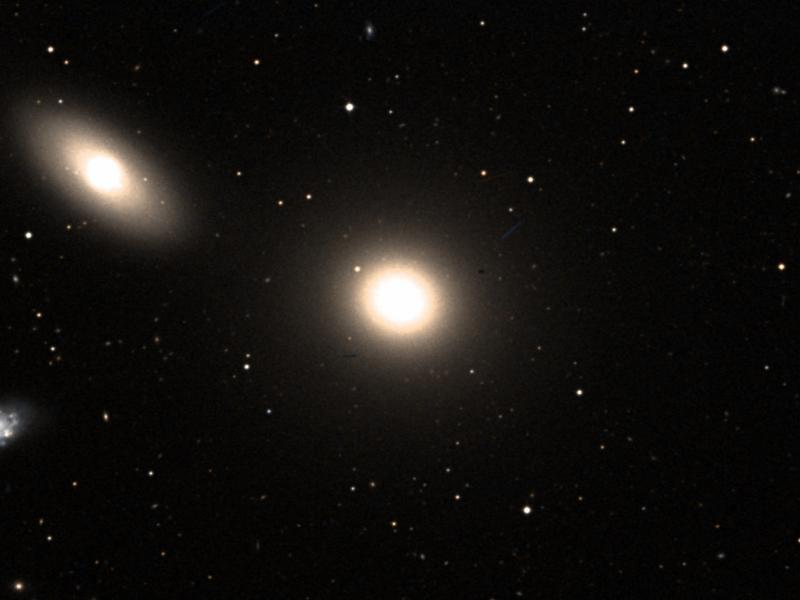
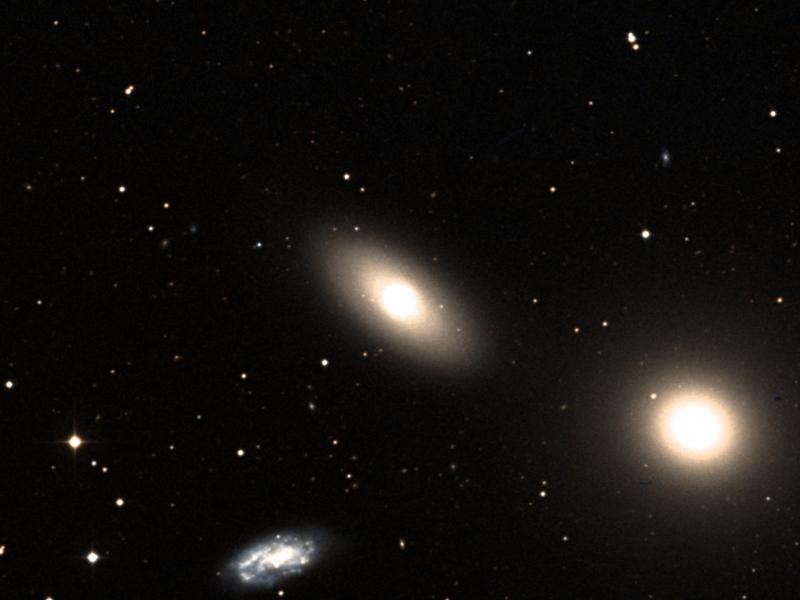
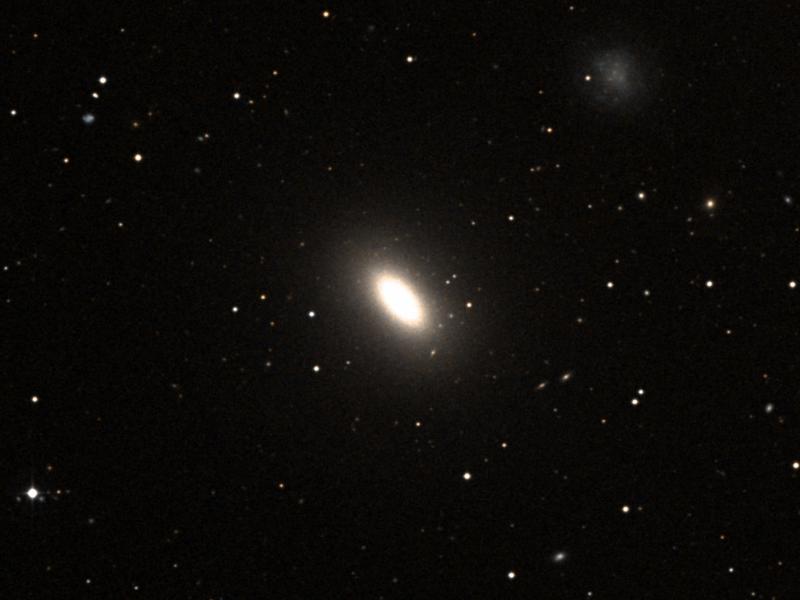
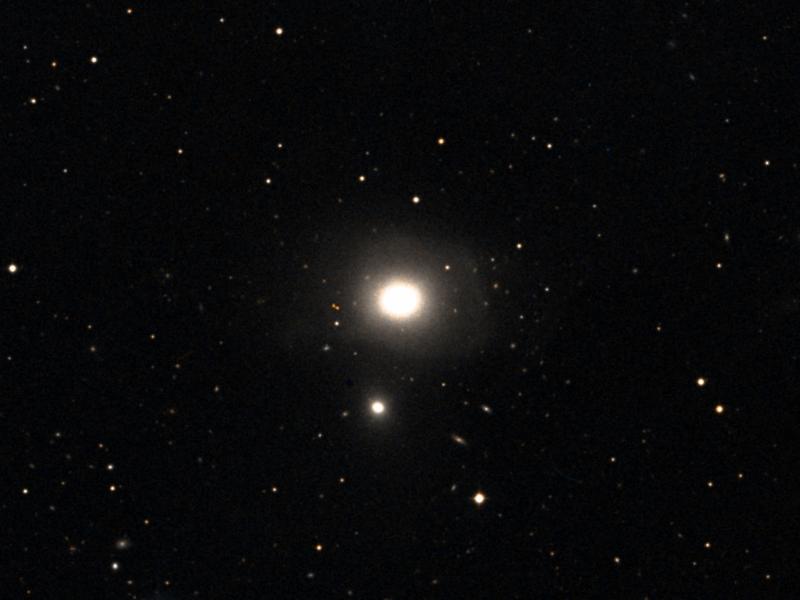
The elliptical of the Leo I group, completing the triangle with M 95 and M 96 — and in the same high-power field as NGC 3384 and faint NGC 3389, three galaxies of three different kinds at once. A textbook round glow, brightening smoothly to the centre.L'elliptique du groupe Leo I, qui complète le triangle avec M 95 et M 96 — et dans le même champ à fort grossissement que NGC 3384 et la pâle NGC 3389, trois galaxies de trois espèces d'un coup. Une lueur ronde d'école, s'intensifiant régulièrement vers le centre.La elíptica del grupo Leo I, que completa el triángulo con M 95 y M 96 — y en el mismo campo de altos aumentos que NGC 3384 y la pálida NGC 3389, tres galaxias de tres clases a la vez. Un resplandor redondo de manual, intensificándose suavemente hacia el centro.Die Elliptische der Leo-I-Gruppe, die das Dreieck mit M 95 und M 96 schließt — und im selben Feld hoher Vergrößerung wie NGC 3384 und die blasse NGC 3389: drei Galaxien dreier Arten auf einmal. Ein rundes Glimmen wie aus dem Lehrbuch, gleichmäßig zur Mitte aufhellend.
small telescopepetit télescopetelescopio pequeñokleines TeleskopDSS2 — STScI/NASA · CDS
TypeTypeTipoTyp
galaxygalaxiegalaxiaGalaxie
ConstellationConstellationConstelaciónSternbild
Leo
MagnitudeMagnitudeMagnitudHelligkeit
9.3
SizeTailleTamañoGröße
7.64′ × 1.97′
Surface brightnessBrillance de surfaceBrillo superficialFlächenhelligkeit
20.9 mag/arcsec²
DistanceDistanceDistanciaEntfernung
about 35 million light-yearsenviron 35 millions d'années-lumièreunos 35 millones de años luzetwa 35 Millionen Lichtjahre
The western member of the Leo Triplet, sharing one low-power field with M 66 and edge-on NGC 3628. A smooth tilted oval, easy at 100 mm; the triplet together is the observation, three spirals at a glance beneath the Lion's hindquarters.Le membre occidental du Triplet du Lion, partageant un champ à faible grossissement avec M 66 et NGC 3628 vue par la tranche. Un ovale incliné et lisse, facile à 100 mm ; le triplet ensemble est l'observation, trois spirales d'un seul regard sous l'arrière-train du Lion.El miembro occidental del Triplete de Leo, compartiendo un campo a pocos aumentos con M 66 y NGC 3628 de canto. Un óvalo inclinado y liso, fácil a 100 mm; el triplete junto es la observación: tres espirales de un vistazo bajo los cuartos traseros del León.Das westliche Mitglied des Leo-Tripletts, im selben Weitwinkelfeld wie M 66 und die Kantenspirale NGC 3628. Ein glattes, geneigtes Oval, leicht bei 100 mm; das Triplett als Ganzes ist die Beobachtung — drei Spiralen auf einen Blick unter dem Hinterteil des Löwen.
small telescopepetit télescopetelescopio pequeñokleines TeleskopDSS2 — STScI/NASA · CDS
TypeTypeTipoTyp
galaxygalaxiegalaxiaGalaxie
ConstellationConstellationConstelaciónSternbild
Leo
MagnitudeMagnitudeMagnitudHelligkeit
9.4
SizeTailleTamañoGröße
11.04′ × 3.44′
Surface brightnessBrillance de surfaceBrillo superficialFlächenhelligkeit
22.0 mag/arcsec²
DistanceDistanceDistanciaEntfernung
about 35 million light-yearsenviron 35 millions d'années-lumièreunos 35 millones de años luzetwa 35 Millionen Lichtjahre
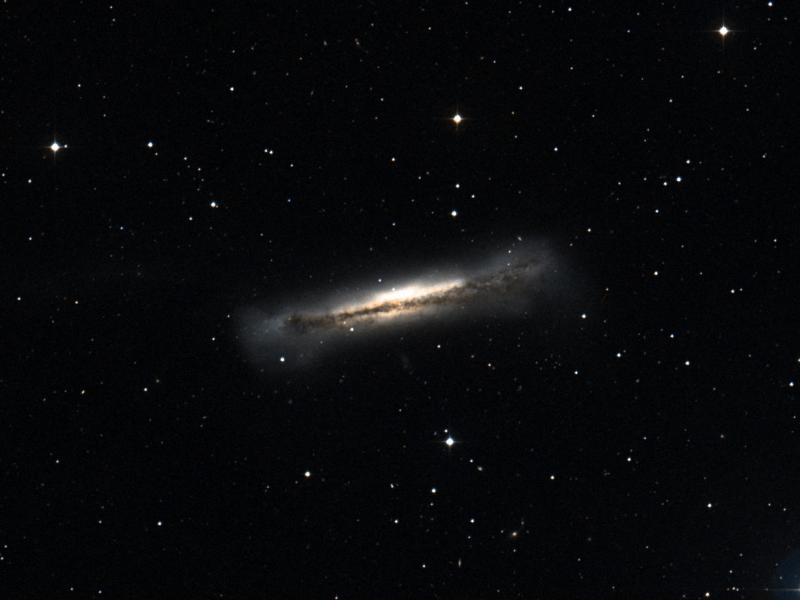
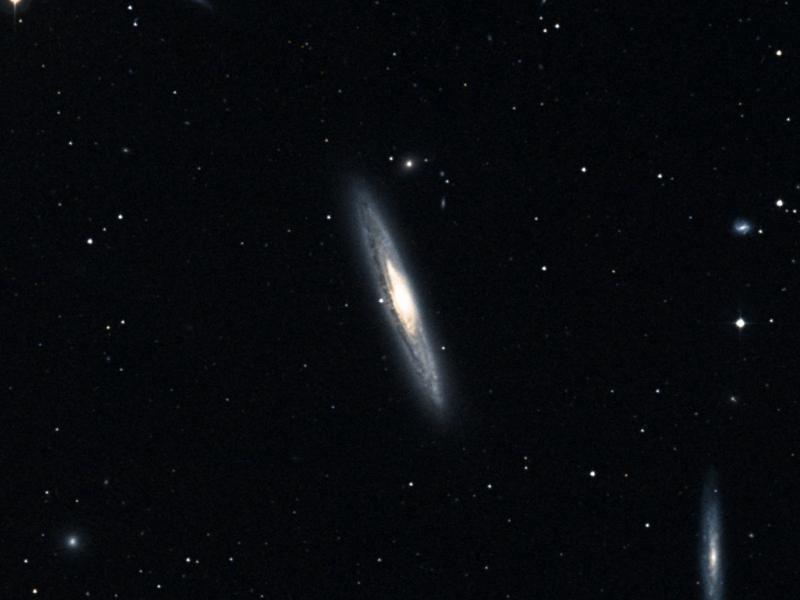
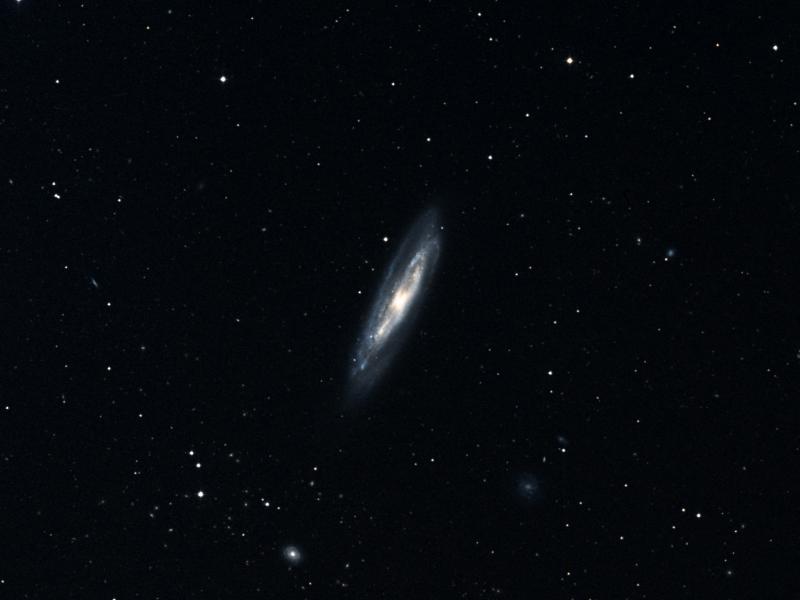
The third vertex of the Leo Triplet and its only edge-on: a long dim streak split by a swollen dust lane — the "Hamburger". The hardest of the three at 150 mm and the most spectacular at 300; its tidal tail, drawn out by the two Messiers, stretches photographic degrees.Le troisième sommet du Triplet du Lion et sa seule tranche : une longue traînée discrète fendue d'une bande de poussière renflée — le « Hamburger ». La plus dure des trois à 150 mm, la plus spectaculaire à 300 ; sa queue de marée, tirée par les deux Messier, s'étire sur des degrés photographiques.El tercer vértice del Triplete de Leo y su única de canto: una veta larga y tenue partida por una banda de polvo hinchada — la "Hamburguesa". La más difícil de las tres a 150 mm y la más espectacular a 300; su cola de marea, estirada por las dos Messier, abarca grados fotográficos.Der dritte Eckpunkt des Leo-Tripletts und seine einzige Kantenlage: ein langer, matter Strich, gespalten von einem geschwollenen Staubband — der "Hamburger". Die schwerste der drei bei 150 mm und die spektakulärste bei 300; ihr Gezeitenschweif, von den beiden Messiers ausgezogen, erstreckt sich über fotografische Grade.
large scope, dark skygrand diamètre, ciel noirgran abertura, cielo oscurogroße Öffnung, dunkler HimmelDSS2 — STScI/NASA · CDS
TypeTypeTipoTyp
galaxygalaxiegalaxiaGalaxie
ConstellationConstellationConstelaciónSternbild
Leo
MagnitudeMagnitudeMagnitudHelligkeit
9.8
SizeTailleTamañoGröße
7.23′ × 4.45′
Surface brightnessBrillance de surfaceBrillo superficialFlächenhelligkeit
22.2 mag/arcsec²
DistanceDistanceDistanciaEntfernung
about 33 million light-yearsenviron 33 millions d'années-lumièreunos 33 millones de años luzetwa 33 Millionen Lichtjahre
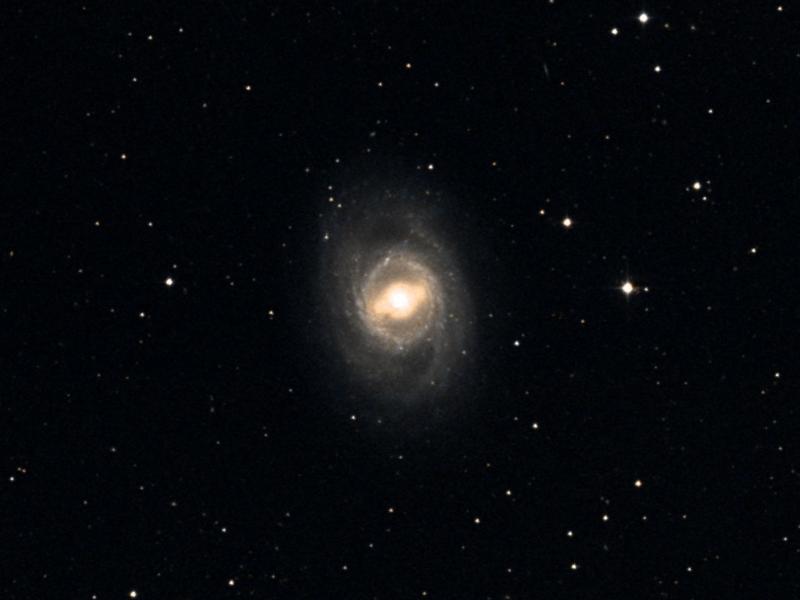
The fainter half of the Leo pair it forms with M 96: a barred spiral whose ring, in photographs, circles the bar like a wreath. In the eyepiece a round glow with a brighter bar-shaped middle. With M 96 and M 105 close by, three Messier galaxies fit one low-power field.La moitié la plus faible de la paire du Lion qu'elle forme avec M 96 : une spirale barrée dont l'anneau, en photographie, entoure la barre comme une couronne. À l'oculaire, une lueur ronde au milieu plus brillant en forme de barre. Avec M 96 et M 105 tout près, trois galaxies de Messier tiennent dans un champ à faible grossissement.La mitad más débil de la pareja de Leo que forma con M 96: una espiral barrada cuyo anillo, en fotografía, rodea la barra como una corona. En el ocular, un resplandor redondo con un centro más brillante en forma de barra. Con M 96 y M 105 al lado, tres galaxias de Messier caben en un campo de pocos aumentos.Die schwächere Hälfte des Löwen-Paares mit M 96: eine Balkenspirale, deren Ring auf Fotos den Balken wie ein Kranz umschließt. Im Okular ein rundes Glimmen mit hellerer, balkenförmiger Mitte. Mit M 96 und M 105 nebenan passen drei Messier-Galaxien in ein Weitwinkelfeld.
large scope, dark skygrand diamètre, ciel noirgran abertura, cielo oscurogroße Öffnung, dunkler HimmelDSS2 — STScI/NASA · CDS
TypeTypeTipoTyp
galaxygalaxiegalaxiaGalaxie
ConstellationConstellationConstelaciónSternbild
Virgo
MagnitudeMagnitudeMagnitudHelligkeit
9.9
SizeTailleTamañoGröße
7.82′ × 1.84′
Surface brightnessBrillance de surfaceBrillo superficialFlächenhelligkeit
21.5 mag/arcsec²
DistanceDistanceDistanciaEntfernung
about 55 million light-yearsenviron 55 millions d'années-lumièreunos 55 millones de años luzetwa 55 Millionen Lichtjahre
The finest edge-on of the Virgo Cluster: a bright silver needle with a bulging core, flanked in the same field by two fainter edge-ons — three spindles in one 200 mm view, a sight photographers call the "Trio in Virgo".La plus belle tranche de l'amas de la Vierge : une aiguille d'argent brillante au cœur renflé, flanquée dans le même champ de deux tranches plus faibles — trois fuseaux dans une seule vue à 200 mm, ce que les photographes appellent le « Trio de la Vierge ».La mejor galaxia de canto del cúmulo de Virgo: una aguja de plata brillante de núcleo abultado, flanqueada en el mismo campo por dos de canto más débiles — tres husos en una sola vista a 200 mm, lo que los fotógrafos llaman el "Trío de Virgo".Die schönste Kantenlage des Virgo-Haufens: eine helle Silbernadel mit gewölbtem Kern, im selben Feld von zwei schwächeren Kantengalaxien flankiert — drei Spindeln in einem 200-mm-Blick, von Fotografen das "Trio in Virgo" genannt.
large scope, dark skygrand diamètre, ciel noirgran abertura, cielo oscurogroße Öffnung, dunkler HimmelDSS2 — STScI/NASA · CDS
TypeTypeTipoTyp
galaxygalaxiegalaxiaGalaxie
ConstellationConstellationConstelaciónSternbild
Leo
MagnitudeMagnitudeMagnitudHelligkeit
10.0
SizeTailleTamañoGröße
5.24′ × 2.37′
Surface brightnessBrillance de surfaceBrillo superficialFlächenhelligkeit
21.3 mag/arcsec²
DistanceDistanceDistanciaEntfernung
about 35 million light-yearsenviron 35 millions d'années-lumièreunos 35 millones de años luzetwa 35 Millionen Lichtjahre
M 105's constant companion: a bright lenticular in the same high-power field, the middle member of the Leo I trio. Comparing its lens shape with the elliptical's round glow is the quick lesson the field offers.La compagne constante de M 105 : une lenticulaire brillante dans le même champ à fort grossissement, membre médian du trio Leo I. Comparer sa forme de lentille à la lueur ronde de l'elliptique est la leçon rapide qu'offre le champ.La compañera constante de M 105: una lenticular brillante en el mismo campo de muchos aumentos, miembro central del trío Leo I. Comparar su forma de lente con el resplandor redondo de la elíptica es la lección rápida que ofrece el campo.M 105s ständige Begleiterin: eine helle Linsengalaxie im selben Feld hoher Vergrößerung, das mittlere Mitglied des Leo-I-Trios. Ihre Linsenform mit dem runden Glimmen der Elliptischen zu vergleichen ist die schnelle Lektion des Feldes.
large scope, dark skygrand diamètre, ciel noirgran abertura, cielo oscurogroße Öffnung, dunkler HimmelDSS2 — STScI/NASA · CDS
TypeTypeTipoTyp
galaxygalaxiegalaxiaGalaxie
ConstellationConstellationConstelaciónSternbild
Leo
MagnitudeMagnitudeMagnitudHelligkeit
10.0
SizeTailleTamañoGröße
4.59′ × 4.03′
Surface brightnessBrillance de surfaceBrillo superficialFlächenhelligkeit
21.8 mag/arcsec²
DistanceDistanceDistanciaEntfernung
about 73 million light-yearsenviron 73 millions d'années-lumièreunos 73 millones de años luzetwa 73 Millionen Lichtjahre
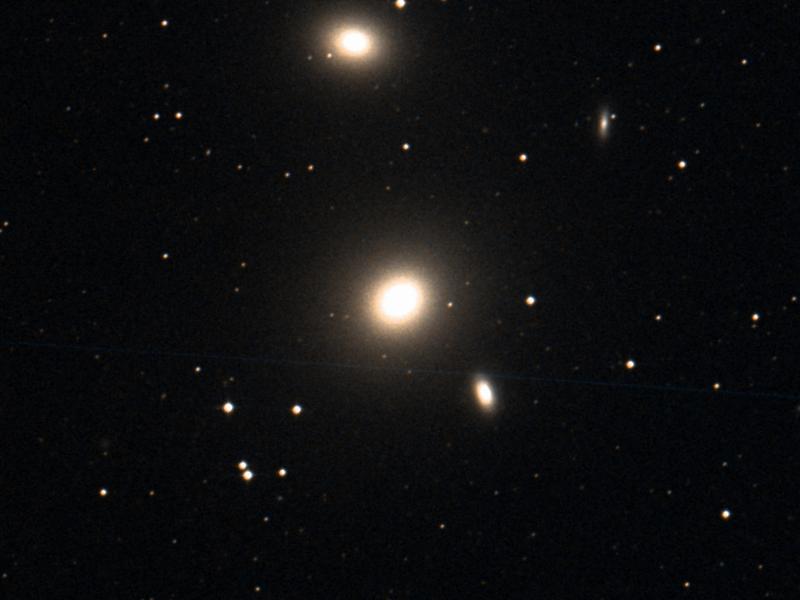
The bright centre of a little trio with NGC 3605 and 3608, halfway along the Lion's belly — three ellipticals in one medium-power field, stepped in brightness like a lesson in limiting magnitude.Le centre brillant d'un petit trio avec NGC 3605 et 3608, à mi-chemin du ventre du Lion — trois elliptiques dans un champ moyen, étagées en éclat comme une leçon de magnitude limite.El centro brillante de un pequeño trío con NGC 3605 y 3608, a medio camino del vientre del León — tres elípticas en un campo medio, escalonadas en brillo como una lección de magnitud límite.Das helle Zentrum eines kleinen Trios mit NGC 3605 und 3608, auf halbem Weg am Bauch des Löwen — drei Elliptische in einem Feld mittlerer Vergrößerung, in der Helligkeit gestuft wie eine Lektion in Grenzgröße.
large scope, dark skygrand diamètre, ciel noirgran abertura, cielo oscurogroße Öffnung, dunkler HimmelDSS2 — STScI/NASA · CDS
TypeTypeTipoTyp
galaxygalaxiegalaxiaGalaxie
ConstellationConstellationConstelaciónSternbild
Leo
MagnitudeMagnitudeMagnitudHelligkeit
10.2
SizeTailleTamañoGröße
3.44′ × 2.03′
Surface brightnessBrillance de surfaceBrillo superficialFlächenhelligkeit
21.0 mag/arcsec²
DistanceDistanceDistanciaEntfernung
about 40 million light-yearsenviron 40 millions d'années-lumièreunos 40 millones de años luzetwa 40 Millionen Lichtjahre
A small, high-surface-brightness lenticular between the Leo I pairs — a bright pip with a sharp core that stands city skies better than most galaxies. Quick to find, quick to log, pleasant to see.Une petite lenticulaire à forte brillance de surface entre les paires de Leo I — un pépin brillant au cœur net, qui supporte le ciel urbain mieux que la plupart des galaxies. Vite trouvée, vite notée, plaisante à voir.Una pequeña lenticular de alto brillo superficial entre las parejas de Leo I — una pepita brillante de núcleo nítido que aguanta el cielo urbano mejor que la mayoría de las galaxias. Rápida de hallar, rápida de anotar, agradable de ver.Eine kleine Linsengalaxie hoher Flächenhelligkeit zwischen den Leo-I-Paaren — ein heller Kern-Punkt, der Stadthimmel besser verträgt als die meisten Galaxien. Schnell gefunden, schnell notiert, angenehm anzusehen.
large scope, dark skygrand diamètre, ciel noirgran abertura, cielo oscurogroße Öffnung, dunkler Himmel
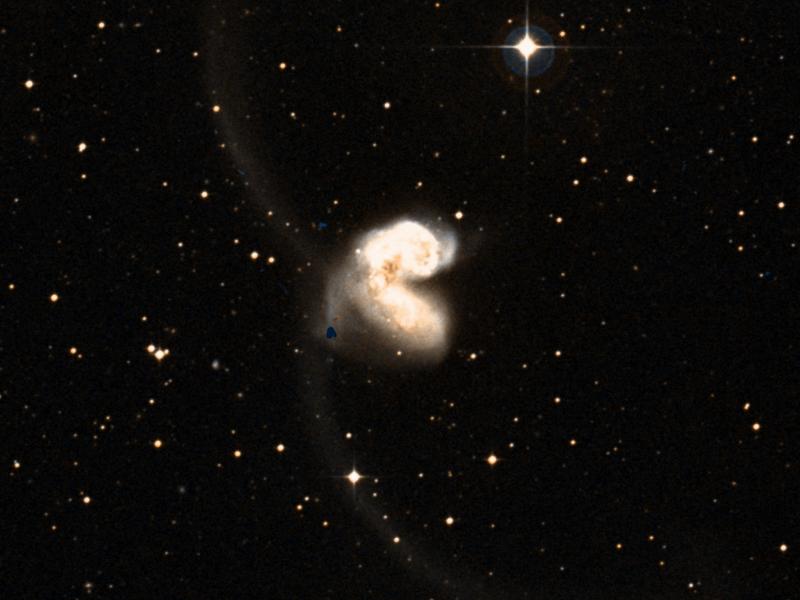
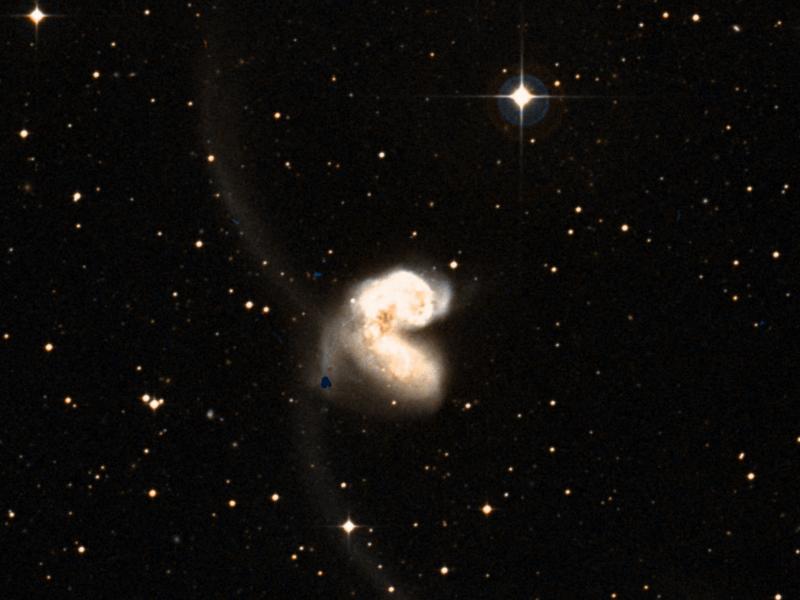
Antennae Galaxies
DSS2 — STScI/NASA · CDS
TypeTypeTipoTyp
galaxygalaxiegalaxiaGalaxie
ConstellationConstellationConstelaciónSternbild
Corvus
MagnitudeMagnitudeMagnitudHelligkeit
11.0
SizeTailleTamañoGröße
5.36′ × 2.73′
Surface brightnessBrillance de surfaceBrillo superficialFlächenhelligkeit
22.6 mag/arcsec²
DistanceDistanceDistanciaEntfernung
about 45 million light-yearsenviron 45 millions d'années-lumièreunos 45 millones de años luzetwa 45 Millionen Lichtjahre
The southern half of the Antennae collision. In the eyepiece the two galaxies read as one bent glow with two cores; calling out which is which at 250 mm is the evening's exercise.La moitié sud de la collision des Antennes. À l'oculaire, les deux galaxies se lisent comme une seule lueur pliée à deux cœurs ; dire laquelle est laquelle à 250 mm est l'exercice de la soirée.La mitad sur de la colisión de las Antenas. En el ocular las dos galaxias se leen como un solo resplandor doblado con dos núcleos; decir cuál es cuál a 250 mm es el ejercicio de la noche.Die Südhälfte der Antennen-Kollision. Im Okular lesen sich die beiden Galaxien als ein geknicktes Glimmen mit zwei Kernen; bei 250 mm zu sagen, welcher welcher ist, ist die Übung des Abends.
Surface brightnessBrillance de surfaceBrillo superficialFlächenhelligkeit
21.3 mag/arcsec²
DistanceDistanceDistanciaEntfernung
about 60 000 light-yearsenviron 60 000 années-lumièreunos 60 000 años luzetwa 60 000 Lichtjahre
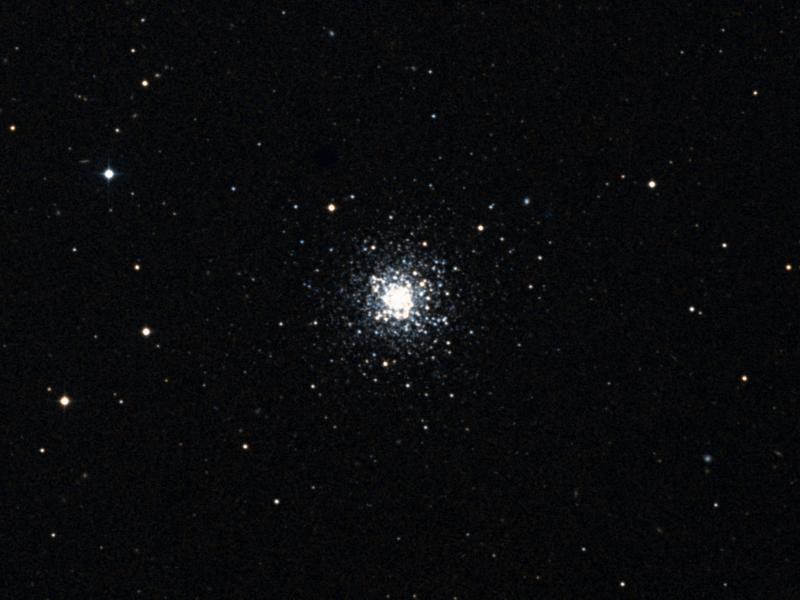
A small halo globular adrift among the Coma galaxies — a compact glow easily mistaken for one more elliptical until high power grains its edge. Another suspected keepsake of the Sagittarius dwarf.Un petit globulaire du halo à la dérive parmi les galaxies de Coma — une lueur compacte facile à prendre pour une elliptique de plus, jusqu'à ce qu'un fort grossissement granule son bord. Encore un souvenir présumé de la naine du Sagittaire.Un pequeño globular del halo a la deriva entre las galaxias de Coma — un resplandor compacto fácil de confundir con una elíptica más, hasta que muchos aumentos granulan su borde. Otro recuerdo presunto de la enana de Sagitario.Ein kleiner Halo-Kugelhaufen, treibend zwischen den Coma-Galaxien — ein kompaktes Glimmen, leicht für eine weitere Elliptische zu halten, bis hohe Vergrößerung seinen Rand körnt. Ein weiteres mutmaßliches Andenken der Schützen-Zwergin.
large scope, dark skygrand diamètre, ciel noirgran abertura, cielo oscurogroße Öffnung, dunkler Himmel
Antennae Galaxies
DSS2 — STScI/NASA · CDS
TypeTypeTipoTyp
galaxygalaxiegalaxiaGalaxie
ConstellationConstellationConstelaciónSternbild
Corvus
MagnitudeMagnitudeMagnitudHelligkeit
10.2
SizeTailleTamañoGröße
5.42′ × 3.78′
Surface brightnessBrillance de surfaceBrillo superficialFlächenhelligkeit
22.1 mag/arcsec²
DistanceDistanceDistanciaEntfernung
about 45 million light-yearsenviron 45 millions d'années-lumièreunos 45 millones de años luzetwa 45 Millionen Lichtjahre
With C 61, two galaxies in the act of colliding — the pair curls into a shrimp-shaped double glow at 200 mm, the famous tidal antennae being a photographic prize. This is the future of the Milky Way and Andromeda, already happening in Corvus.Avec C 61, deux galaxies en pleine collision — la paire se recourbe en double lueur en forme de crevette à 200 mm, les célèbres antennes de marée restant un trophée photographique. C'est l'avenir de la Voie lactée et d'Andromède, déjà en cours dans le Corbeau.Con C 61, dos galaxias en plena colisión — la pareja se curva en un doble resplandor con forma de gamba a 200 mm; las célebres antenas de marea quedan como trofeo fotográfico. Es el futuro de la Vía Láctea y Andrómeda, ya en marcha en el Cuervo.Mit C 61 zwei Galaxien mitten im Zusammenstoß — das Paar krümmt sich bei 200 mm zu einem garnelenförmigen Doppelschein; die berühmten Gezeitenantennen bleiben eine fotografische Trophäe. Dies ist die Zukunft von Milchstraße und Andromeda, im Raben schon im Gange.
large scope, dark skygrand diamètre, ciel noirgran abertura, cielo oscurogroße Öffnung, dunkler HimmelDSS2 — STScI/NASA · CDS
TypeTypeTipoTyp
galaxygalaxiegalaxiaGalaxie
ConstellationConstellationConstelaciónSternbild
Leo
MagnitudeMagnitudeMagnitudHelligkeit
10.3
SizeTailleTamañoGröße
3.87′ × 1.87′
Surface brightnessBrillance de surfaceBrillo superficialFlächenhelligkeit
21.0 mag/arcsec²
DistanceDistanceDistanciaEntfernung
about 35 million light-yearsenviron 35 millions d'années-lumièreunos 35 millones de años luzetwa 35 Millionen Lichtjahre
A modest elliptical of the Leo I group north of the M 105 trio — a soft oval with a bright nucleus, part of the constellation-wide family portrait this patch of Leo offers at low power.Une elliptique modeste du groupe Leo I au nord du trio de M 105 — un ovale doux au noyau brillant, un membre du portrait de famille que ce coin du Lion offre à faible grossissement.Una elíptica modesta del grupo Leo I al norte del trío de M 105 — un óvalo suave de núcleo brillante, parte del retrato de familia que este rincón de Leo ofrece a pocos aumentos.Eine bescheidene Elliptische der Leo-I-Gruppe nördlich des M-105-Trios — ein weiches Oval mit hellem Kern, Teil des Familienporträts, das dieser Fleck des Löwen bei schwacher Vergrößerung bietet.
large scope, dark skygrand diamètre, ciel noirgran abertura, cielo oscurogroße Öffnung, dunkler HimmelDSS2 — STScI/NASA · CDS
TypeTypeTipoTyp
galaxygalaxiegalaxiaGalaxie
ConstellationConstellationConstelaciónSternbild
Leo
MagnitudeMagnitudeMagnitudHelligkeit
10.4
SizeTailleTamañoGröße
4.33′ × 3.81′
Surface brightnessBrillance de surfaceBrillo superficialFlächenhelligkeit
22.1 mag/arcsec²
DistanceDistanceDistanciaEntfernung
about 75 million light-yearsenviron 75 millions d'années-lumièreunos 75 millones de años luzetwa 75 Millionen Lichtjahre
A round elliptical in Leo's hind leg with a faint companion at its southern rim — smooth, condensed, quick at 200 mm; deep images reveal the shells of its merging past.Une elliptique ronde dans la patte arrière du Lion, une compagne pâle à son bord sud — lisse, condensée, vite vue à 200 mm ; les images profondes révèlent les coquilles de son passé de fusions.Una elíptica redonda en la pata trasera de Leo con una compañera tenue en su borde sur — lisa, condensada, rápida a 200 mm; las imágenes profundas revelan las capas de su pasado de fusiones.Eine runde Elliptische im Hinterbein des Löwen mit einer blassen Begleiterin am Südrand — glatt, verdichtet, schnell bei 200 mm; tiefe Aufnahmen enthüllen die Schalen ihrer Verschmelzungsvergangenheit.
large scope, dark skygrand diamètre, ciel noirgran abertura, cielo oscurogroße Öffnung, dunkler HimmelDSS2 — STScI/NASA · CDS
TypeTypeTipoTyp
galaxygalaxiegalaxiaGalaxie
ConstellationConstellationConstelaciónSternbild
Virgo
MagnitudeMagnitudeMagnitudHelligkeit
10.5
SizeTailleTamañoGröße
3.78′ × 2.65′
Surface brightnessBrillance de surfaceBrillo superficialFlächenhelligkeit
21.6 mag/arcsec²
DistanceDistanceDistanciaEntfernung
about 75 million light-yearsenviron 75 millions d'années-lumièreunos 75 millones de años luzetwa 75 Millionen Lichtjahre
A bright, tightly wound spiral south of the Virgo Cluster proper — a condensed oval at 200 mm, its silky multi-arm disc one of the photogenic secrets of the constellation's quieter half.Une spirale brillante et serrée au sud de l'amas de la Vierge proprement dit — un ovale condensé à 200 mm, son disque soyeux multi-bras étant l'un des secrets photogéniques de la moitié plus calme de la constellation.Una espiral brillante y apretada al sur del cúmulo de Virgo propiamente dicho — un óvalo condensado a 200 mm, cuyo disco sedoso de varios brazos es uno de los secretos fotogénicos de la mitad más tranquila de la constelación.Eine helle, eng gewundene Spirale südlich des eigentlichen Virgo-Haufens — ein verdichtetes Oval bei 200 mm, ihre seidige Mehrarm-Scheibe eines der fotogenen Geheimnisse der stilleren Hälfte des Sternbilds.
large scope, dark skygrand diamètre, ciel noirgran abertura, cielo oscurogroße Öffnung, dunkler HimmelDSS2 — STScI/NASA · CDS
TypeTypeTipoTyp
galaxygalaxiegalaxiaGalaxie
ConstellationConstellationConstelaciónSternbild
Leo
MagnitudeMagnitudeMagnitudHelligkeit
10.5
SizeTailleTamañoGröße
3.96′ × 2.17′
Surface brightnessBrillance de surfaceBrillo superficialFlächenhelligkeit
21.5 mag/arcsec²
DistanceDistanceDistanciaEntfernung
about 36 million light-yearsenviron 36 millions d'années-lumièreunos 36 millones de años luzetwa 36 Millionen Lichtjahre
A bright little lenticular in the Leo I neighbourhood — a lens with a sharp core at 150 mm, one of the easy fill-ins that make this patch of Leo a one-field galaxy school.Une petite lenticulaire brillante dans le voisinage de Leo I — une lentille au cœur net à 150 mm, l'un des compléments faciles qui font de ce coin du Lion une école de galaxies en un champ.Una lenticular pequeña y brillante en el vecindario de Leo I — una lente de núcleo nítido a 150 mm, uno de los rellenos fáciles que hacen de este rincón de Leo una escuela de galaxias en un campo.Eine helle kleine Linsengalaxie in der Leo-I-Nachbarschaft — eine Linse mit scharfem Kern bei 150 mm, eine der leichten Ergänzungen, die diesen Fleck des Löwen zur Ein-Feld-Galaxienschule machen.
large scope, dark skygrand diamètre, ciel noirgran abertura, cielo oscurogroße Öffnung, dunkler HimmelDSS2 — STScI/NASA · CDS
TypeTypeTipoTyp
galaxygalaxiegalaxiaGalaxie
ConstellationConstellationConstelaciónSternbild
Coma Berenices
MagnitudeMagnitudeMagnitudHelligkeit
10.8
SizeTailleTamañoGröße
11.04′ × 2.66′
Surface brightnessBrillance de surfaceBrillo superficialFlächenhelligkeit
23.1 mag/arcsec²
DistanceDistanceDistanciaEntfernung
about 44 million light-yearsenviron 44 millions d'années-lumièreunos 44 millones de años luzetwa 44 Millionen Lichtjahre
A near-edge-on spiral at the western gate of the Virgo Cluster, half a degree from the star 6 Comae that guides every Virgo sweep. An elongated pale streak with a modest core — the faintest of the three Messiers around that star, and the shapeliest.Une spirale presque par la tranche à la porte ouest de l'amas de la Vierge, à un demi-degré de l'étoile 6 Comae qui guide tout parcours de la Vierge. Une traînée pâle et allongée au cœur modeste — la plus faible des trois Messier autour de cette étoile, et la plus galbée.Una espiral casi de canto en la puerta oeste del cúmulo de Virgo, a medio grado de la estrella 6 Comae que guía todo barrido de Virgo. Una veta pálida y alargada de núcleo modesto — la más débil de las tres Messier en torno a esa estrella, y la más esbelta.Eine fast in Kantenlage stehende Spirale am Westtor des Virgo-Haufens, ein halbes Grad vom Stern 6 Comae, der jeden Virgo-Schwenk führt. Ein blasser, gestreckter Strich mit bescheidenem Kern — die schwächste der drei Messiers um diesen Stern, und die formschönste.
Both stars bright enough for a small telescope, wide enough to split.Deux composantes assez brillantes pour un petit télescope, assez écartées pour être séparées.Ambas componentes lo bastante brillantes para un telescopio pequeño y separables.Beide Komponenten hell genug für ein kleines Teleskop und weit genug zum Trennen.
Sep.Sép.Sep.Abstand
PAAPAPPW
MagsMagsMagsHelligkeiten
ι Leo
2.3″
90°
4.1 / 6.7
γ Crt
4.4″
92°
4.1 / 7.9
TX Leo
2.1″
155°
5.8 / 7.9
35 Sex
6.8″
239°
6.2 / 7.1
90 Leo
3.1″
209°
6.3 / 7.3
83 Leo
28.6″
146°
6.5 / 7.5
HD 93526
6.6″
15°
7.0 / 7.6
40 Sex
2.5″
17°
7.1 / 7.8
HD 98427
9.3″
253°
7.1 / 7.9
HD 103047
30.5″
210°
7.4 / 7.9
Also on this chartAussi sur cette carteTambién en esta cartaEbenfalls auf dieser Karte
22 · Everything else the chart plots, easiest first where a rank exists.Tout le reste de la carte, du plus facile au plus difficile quand un classement existe.Todo lo demás que traza la carta, de lo más fácil a lo más difícil cuando hay clasificación.Alles Übrige auf der Karte, wo möglich nach Schwierigkeit geordnet.