20 objects on this chartobjets sur cette carteobjetos en esta cartaObjekte auf dieser Karte
Easiest firstLes plus faciles d'abordLos más fáciles primeroDie einfachsten zuerst
What this chart shows, in the order you should try: start where success is certain, work toward the hard ones.Ce que montre cette carte, dans l'ordre où l'essayer : commencez là où le succès est certain, avancez vers le difficile.Lo que muestra esta carta, en el orden en que conviene intentarlo: empiece donde el éxito es seguro y avance hacia lo difícil.Was diese Karte zeigt, in der Reihenfolge, in der man es versuchen sollte: Beginnen Sie, wo der Erfolg sicher ist, und arbeiten Sie sich vor.
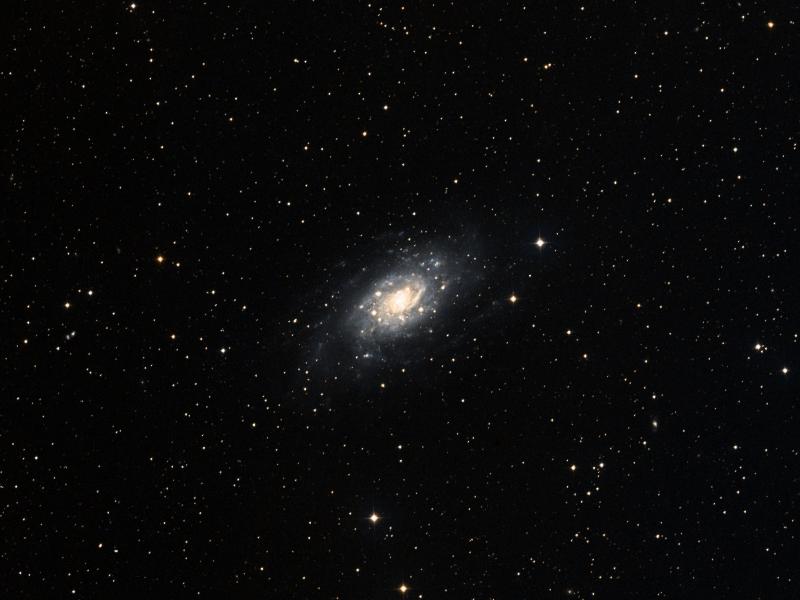
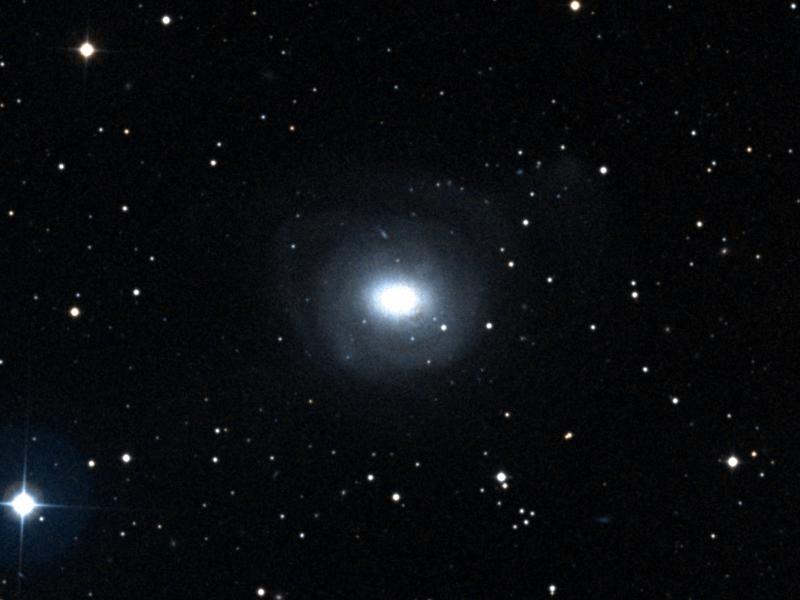
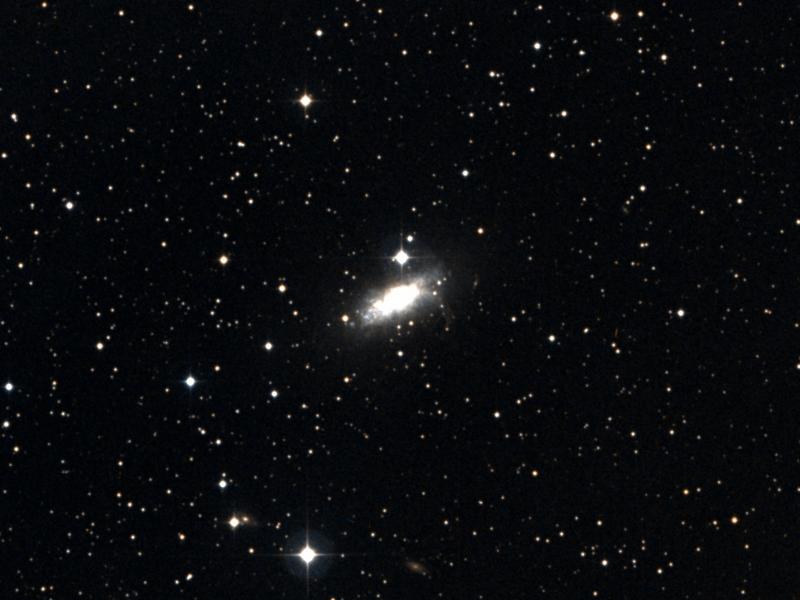
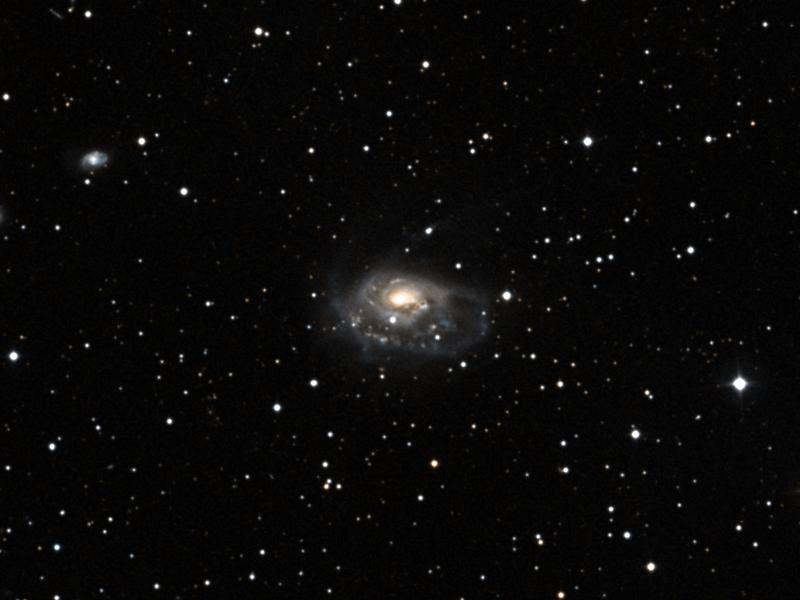
NGC 2403
small telescopepetit télescopetelescopio pequeñokleines TeleskopDSS2 — STScI/NASA · CDS
TypeTypeTipoTyp
galaxygalaxiegalaxiaGalaxie
ConstellationConstellationConstelaciónSternbild
Camelopardalis
MagnitudeMagnitudeMagnitudHelligkeit
8.4
SizeTailleTamañoGröße
19.95′ × 10.07′
Surface brightnessBrillance de surfaceBrillo superficialFlächenhelligkeit
22.8 mag/arcsec²
DistanceDistanceDistanciaEntfernung
about 10 million light-yearsenviron 10 millions d'années-lumièreunos 10 millones de años luzetwa 10 Millionen Lichtjahre
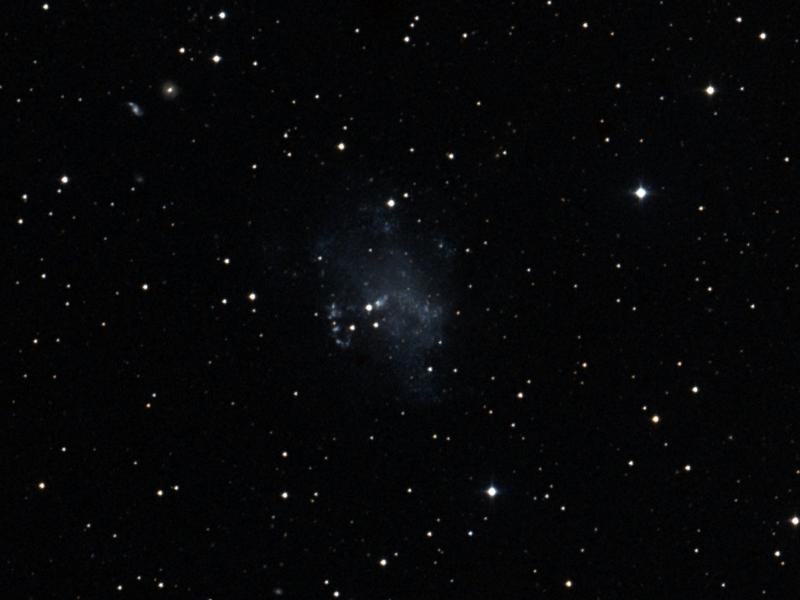
The brightest galaxy the Messier catalogue missed: an M 33 in miniature in Camelopardalis, easy in binoculars from a dark site. 250 mm show a mottled disc with hints of arm; its giant star-forming region NGC 2404 appears as a faint knot.La plus brillante galaxie que le catalogue de Messier ait manquée : une M 33 en miniature dans la Girafe, facile aux jumelles depuis un site sombre. 250 mm montrent un disque marbré aux bras esquissés ; sa région de formation d'étoiles géante NGC 2404 apparaît en nœud pâle.La galaxia más brillante que el catálogo de Messier pasó por alto: una M 33 en miniatura en la Jirafa, fácil en prismáticos desde sitio oscuro. 250 mm muestran un disco moteado con brazos insinuados; su región gigante de formación estelar NGC 2404 aparece como un nudo tenue.Die hellste Galaxie, die dem Messier-Katalog entging: eine M 33 im Kleinen in der Giraffe, vom dunklen Standort leicht im Fernglas. 250 mm zeigen eine gesprenkelte Scheibe mit angedeuteten Armen; ihre riesige Sternentstehungsregion NGC 2404 erscheint als blasser Knoten.
Surface brightnessBrillance de surfaceBrillo superficialFlächenhelligkeit
15.1 mag/arcsec²
DistanceDistanceDistanciaEntfernung
about 3 600 light-yearsenviron 3 600 années-lumièreunos 3 600 años luzetwa 3 600 Lichtjahre
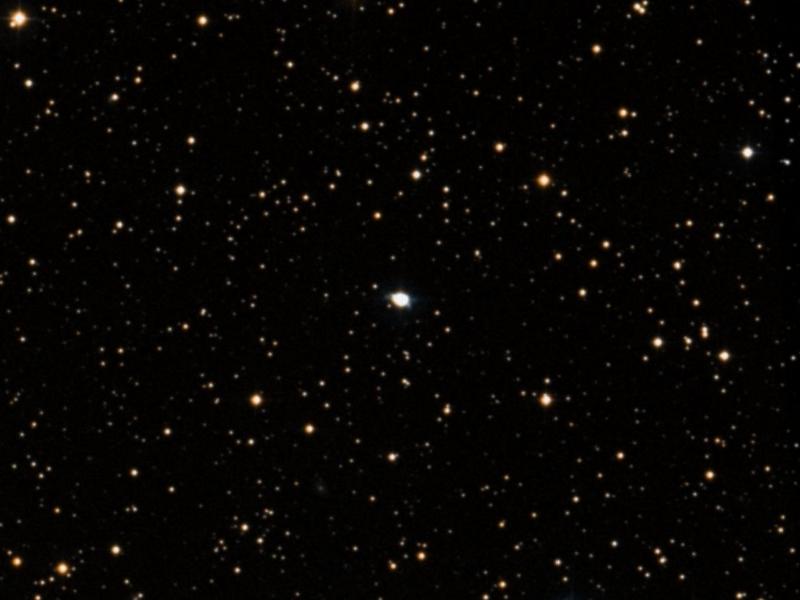
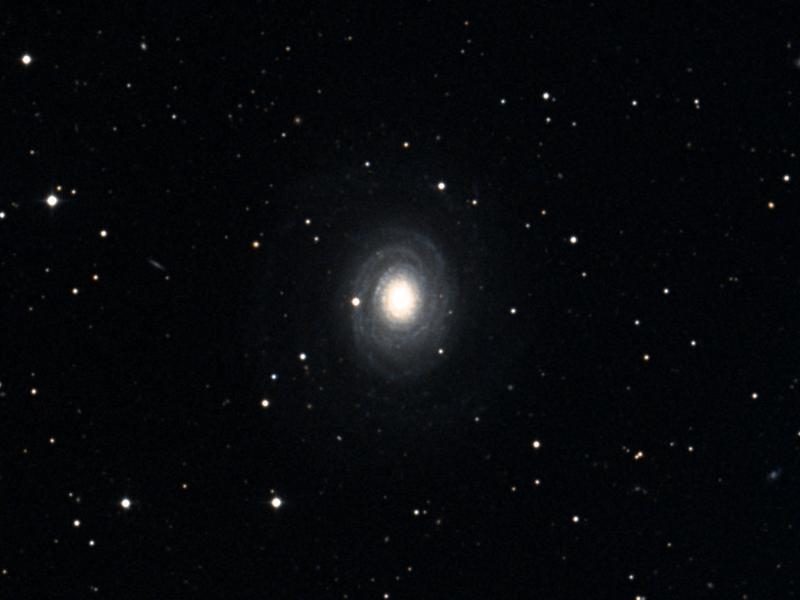
A small bright planetary beside Menkalinan in Auriga — a bluish near-stellar disc with a visible central star, quick to find from the naked-eye anchor and rewarding at 250×.Une petite planétaire brillante près de Menkalinan dans le Cocher — un disque bleuté quasi stellaire à l'étoile centrale visible, vite trouvé depuis l'ancre à l'œil nu et gratifiant à 250×.Una pequeña planetaria brillante junto a Menkalinan en el Cochero — un disco azulado casi estelar con estrella central visible, rápida de hallar desde el ancla a simple vista y gratificante a 250×.Ein kleiner heller Planetarischer neben Menkalinan im Fuhrmann — eine bläuliche, fast sternförmige Scheibe mit sichtbarem Zentralstern, schnell vom freiäugigen Anker gefunden und lohnend bei 250×.
large scope, dark skygrand diamètre, ciel noirgran abertura, cielo oscurogroße Öffnung, dunkler HimmelDSS2 — STScI/NASA · CDS
TypeTypeTipoTyp
galaxygalaxiegalaxiaGalaxie
ConstellationConstellationConstelaciónSternbild
Camelopardalis
MagnitudeMagnitudeMagnitudHelligkeit
9.7
SizeTailleTamañoGröße
19.77′ × 18.79′
Surface brightnessBrillance de surfaceBrillo superficialFlächenhelligkeit
24.7 mag/arcsec²
DistanceDistanceDistanciaEntfernung
about 11 million light-yearsenviron 11 millions d'années-lumièreunos 11 millones de años luzetwa 11 Millionen Lichtjahre
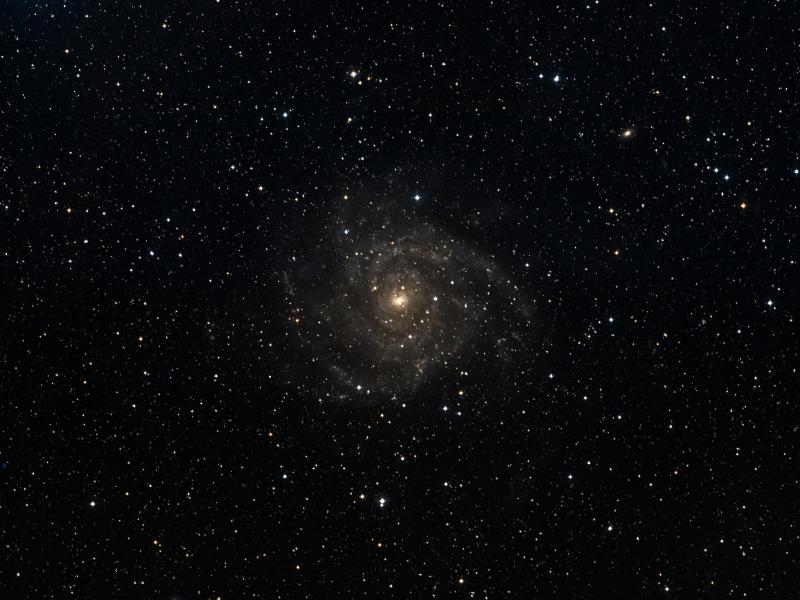
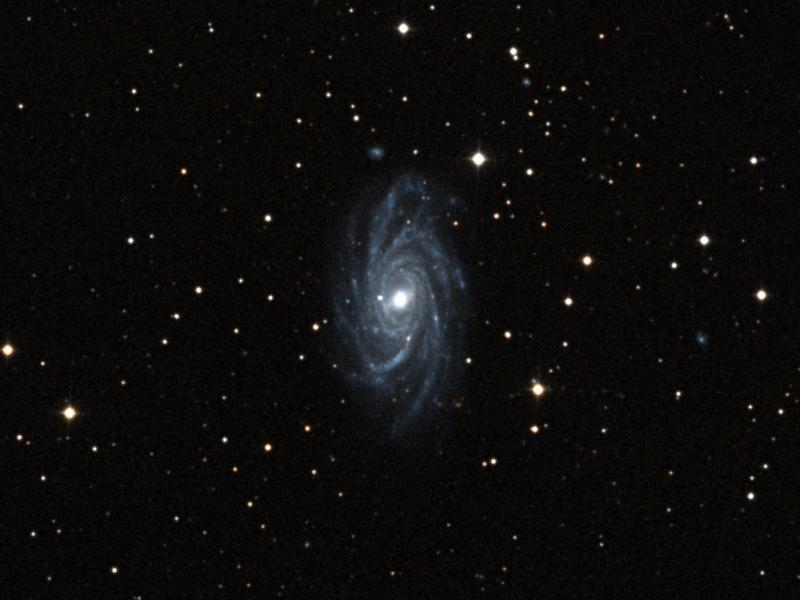
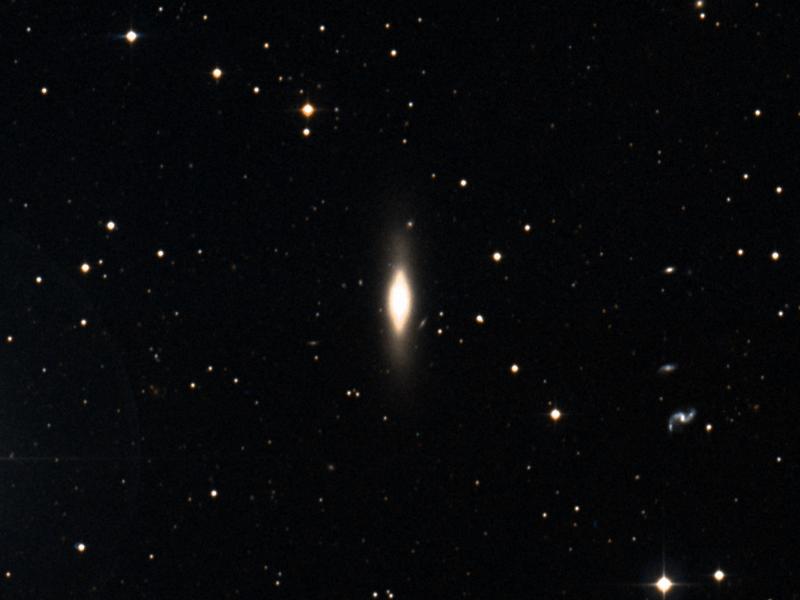
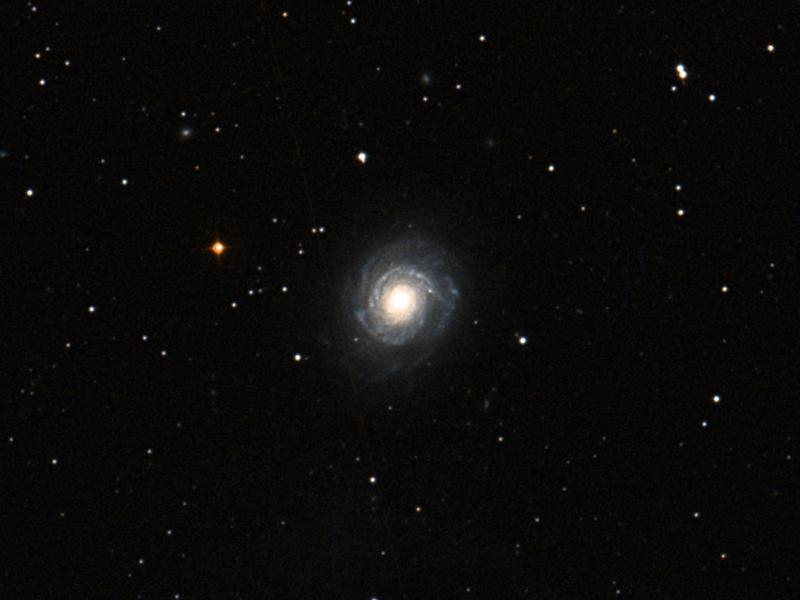
The Hidden Galaxy: a grand face-on spiral that would rival M 33 if it did not sit behind the dust of the Milky Way's plane, which steals two magnitudes. A big, dim glow with a stellar core in Camelopardalis; binoculars under a superb sky, or 200 mm under a good one.La Galaxie cachée : une grande spirale de face qui rivaliserait avec M 33 si elle ne siégeait derrière la poussière du plan de la Voie lactée, qui lui vole deux magnitudes. Une lueur grande et faible à cœur stellaire dans la Girafe ; jumelles sous un ciel superbe, ou 200 mm sous un bon ciel.La Galaxia Oculta: una gran espiral de frente que rivalizaría con M 33 si no estuviera tras el polvo del plano de la Vía Láctea, que le roba dos magnitudes. Un resplandor grande y tenue de núcleo estelar en la Jirafa; prismáticos bajo un cielo soberbio, o 200 mm bajo uno bueno.Die Verborgene Galaxie: eine große Spirale in Draufsicht, die M 33 Konkurrenz machte, säße sie nicht hinter dem Staub der Milchstraßenebene, der ihr zwei Größenklassen stiehlt. Ein großes, mattes Glimmen mit Sternkern in der Giraffe; Fernglas unter erstklassigem Himmel, sonst 200 mm.
large scope, dark skygrand diamètre, ciel noirgran abertura, cielo oscurogroße Öffnung, dunkler HimmelDSS2 — STScI/NASA · CDS
TypeTypeTipoTyp
galaxygalaxiegalaxiaGalaxie
ConstellationConstellationConstelaciónSternbild
Camelopardalis
MagnitudeMagnitudeMagnitudHelligkeit
10.2
SizeTailleTamañoGröße
4.02′ × 3.73′
Surface brightnessBrillance de surfaceBrillo superficialFlächenhelligkeit
21.8 mag/arcsec²
DistanceDistanceDistanciaEntfernung
about 50 million light-yearsenviron 50 millions d'années-lumièreunos 50 millones de años luzetwa 50 Millionen Lichtjahre
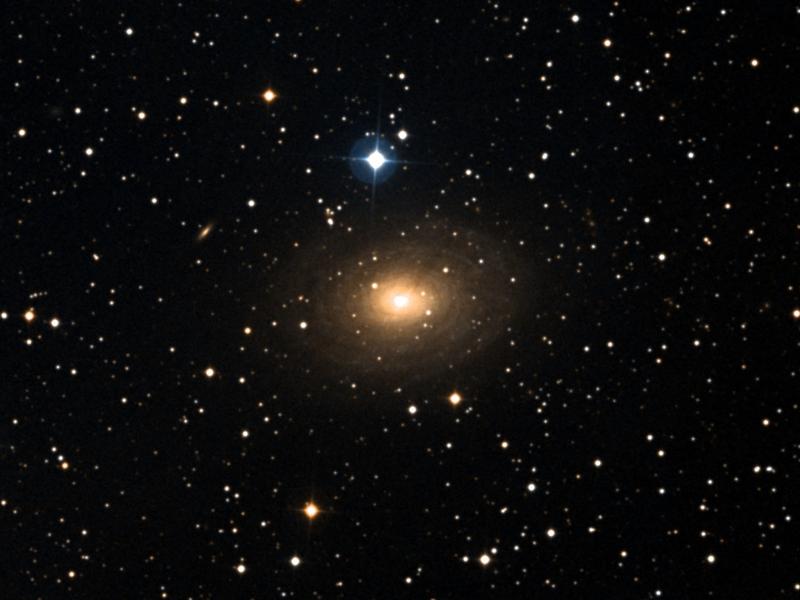
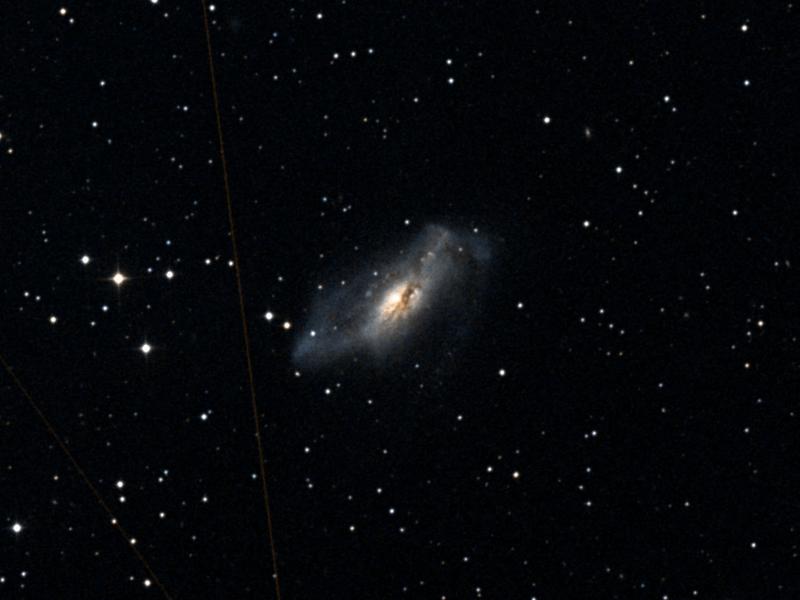
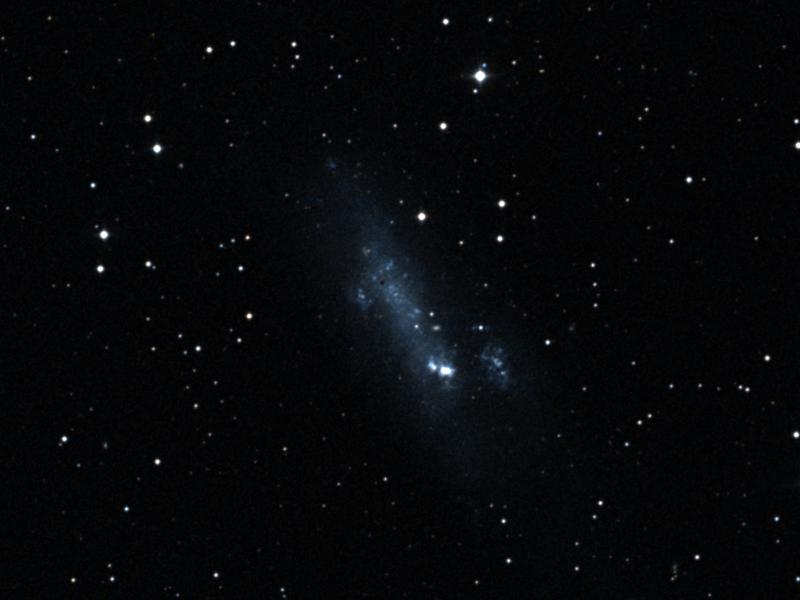
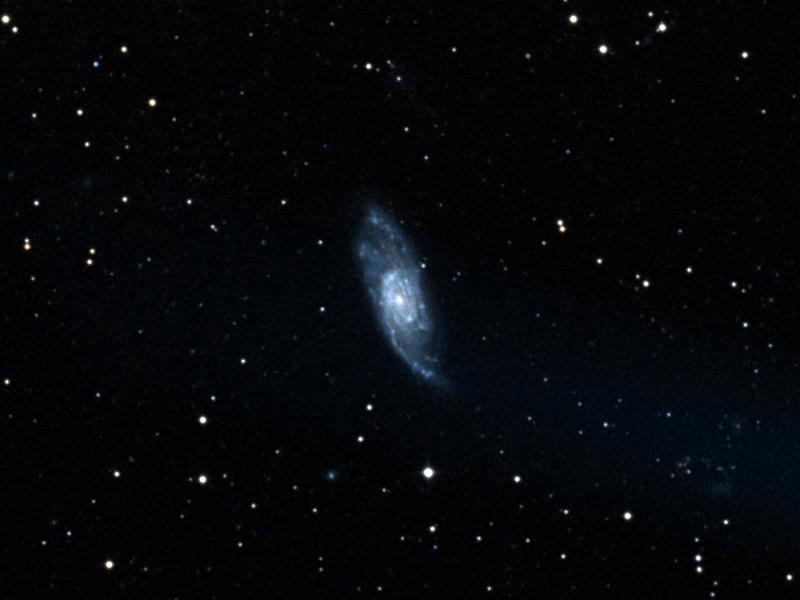
A big tilted spiral behind Camelopardalis's dust, beside a bright field star — reddened, dimmed, and still an easy 200 mm oval.Une grande spirale inclinée derrière la poussière de la Girafe, près d'une brillante étoile de champ — rougie, éteinte, et pourtant un ovale facile à 200 mm.Una gran espiral inclinada tras el polvo de la Jirafa, junto a una brillante estrella de campo — enrojecida, apagada, y aun así un óvalo fácil a 200 mm.Eine große geneigte Spirale hinter dem Staub der Giraffe, neben einem hellen Feldstern — gerötet, gedämpft, und doch ein leichtes 200-mm-Oval.
large scope, dark skygrand diamètre, ciel noirgran abertura, cielo oscurogroße Öffnung, dunkler HimmelDSS2 — STScI/NASA · CDS
TypeTypeTipoTyp
galaxygalaxiegalaxiaGalaxie
ConstellationConstellationConstelaciónSternbild
Camelopardalis
MagnitudeMagnitudeMagnitudHelligkeit
10.4
SizeTailleTamañoGröße
3.93′ × 2.06′
Surface brightnessBrillance de surfaceBrillo superficialFlächenhelligkeit
21.3 mag/arcsec²
DistanceDistanceDistanciaEntfernung
about 65 million light-yearsenviron 65 millions d'années-lumièreunos 65 millones de años luzetwa 65 Millionen Lichtjahre
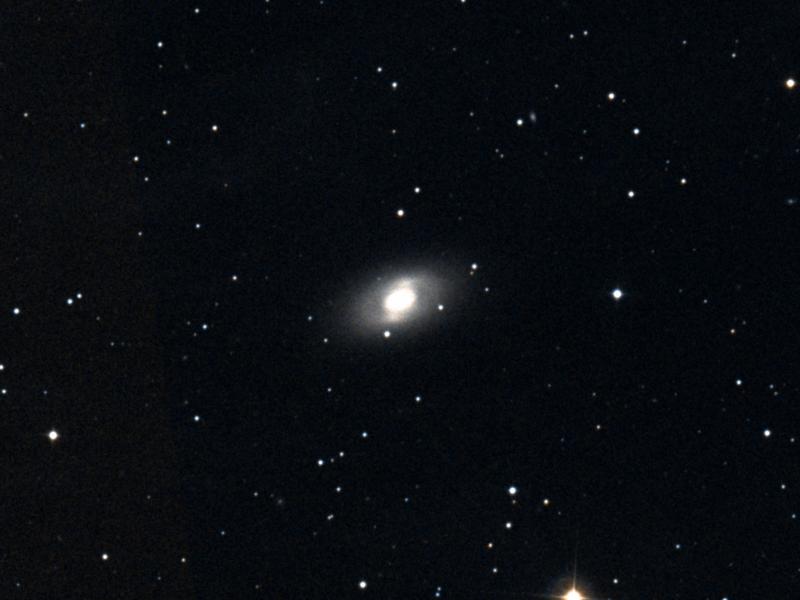
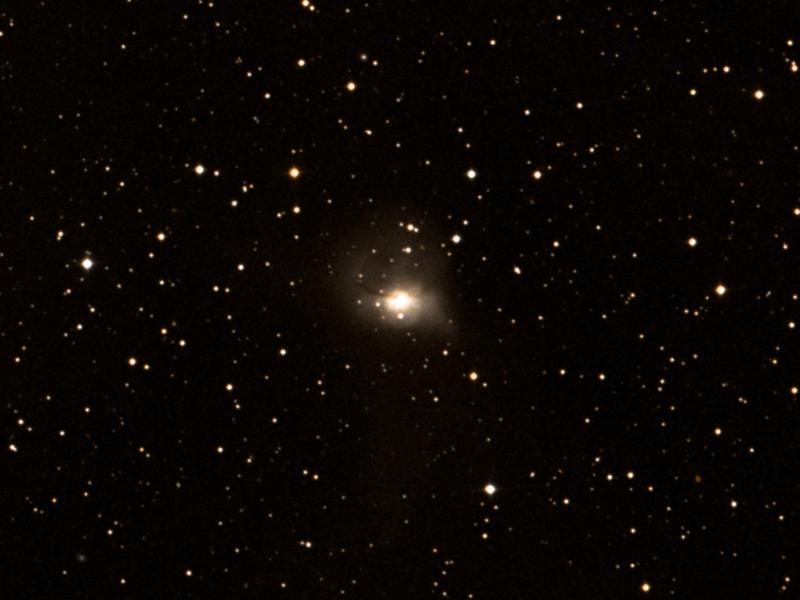
A bright lenticular anchoring dim Camelopardalis — an easy condensed glow at 150 mm with a Seyfert nucleus and, in deep images, shells from a recent merger. The best galaxy in a constellation famous for having nothing.Une lenticulaire brillante ancrant la discrète Girafe — une lueur condensée facile à 150 mm, au noyau de Seyfert et, sur les images profondes, aux coquilles d'une fusion récente. La meilleure galaxie d'une constellation célèbre pour n'avoir rien.Una lenticular brillante que ancla a la tenue Jirafa — un resplandor condensado fácil a 150 mm, con núcleo Seyfert y, en imágenes profundas, capas de una fusión reciente. La mejor galaxia de una constelación famosa por no tener nada.Eine helle Linsengalaxie als Anker der unscheinbaren Giraffe — ein leichtes, verdichtetes Glimmen bei 150 mm mit Seyfert-Kern und auf tiefen Aufnahmen Schalen einer jungen Verschmelzung. Die beste Galaxie eines Sternbilds, das dafür berühmt ist, nichts zu haben.
large scope, dark skygrand diamètre, ciel noirgran abertura, cielo oscurogroße Öffnung, dunkler HimmelDSS2 — STScI/NASA · CDS
TypeTypeTipoTyp
galaxygalaxiegalaxiaGalaxie
ConstellationConstellationConstelaciónSternbild
Ursa Major
MagnitudeMagnitudeMagnitudHelligkeit
10.5
SizeTailleTamañoGröße
3.61′ × 2.92′
Surface brightnessBrillance de surfaceBrillo superficialFlächenhelligkeit
21.7 mag/arcsec²
DistanceDistanceDistanciaEntfernung
about 70 million light-yearsenviron 70 millions d'années-lumièreunos 70 millones de años luzetwa 70 Millionen Lichtjahre
A tightly wound spiral in the Great Bear's far north — a small round glow with a bright core at 200 mm, circumpolar and available any clear night of the year.Une spirale serrée dans le grand nord de la Grande Ourse — une petite lueur ronde au cœur brillant à 200 mm, circumpolaire et disponible chaque nuit claire de l'année.Una espiral apretada en el extremo norte de la Osa Mayor — un pequeño resplandor redondo de núcleo brillante a 200 mm, circumpolar y disponible cualquier noche clara del año.Eine eng gewundene Spirale im hohen Norden des Großen Bären — ein kleines rundes Glimmen mit hellem Kern bei 200 mm, zirkumpolar und in jeder klaren Nacht des Jahres verfügbar.
large scope, dark skygrand diamètre, ciel noirgran abertura, cielo oscurogroße Öffnung, dunkler HimmelDSS2 — STScI/NASA · CDS
TypeTypeTipoTyp
galaxygalaxiegalaxiaGalaxie
ConstellationConstellationConstelaciónSternbild
Camelopardalis
MagnitudeMagnitudeMagnitudHelligkeit
10.7
SizeTailleTamañoGröße
5.01′ × 2.81′
Surface brightnessBrillance de surfaceBrillo superficialFlächenhelligkeit
22.2 mag/arcsec²
DistanceDistanceDistanciaEntfernung
about 100 million light-yearsenviron 100 millions d'années-lumièreunos 100 millones de años luzetwa 100 Millionen Lichtjahre
A serene barred spiral near the pole in Camelopardalis — a soft oval at 250 mm, circumpolar and elegant in photographs.Une spirale barrée sereine près du pôle dans la Girafe — un ovale doux à 250 mm, circumpolaire et élégante en photographie.Una espiral barrada serena cerca del polo en la Jirafa — un óvalo suave a 250 mm, circumpolar y elegante en fotografía.Eine ruhige Balkenspirale nahe dem Pol in der Giraffe — ein weiches Oval bei 250 mm, zirkumpolar und elegant auf Fotos.
large scope, dark skygrand diamètre, ciel noirgran abertura, cielo oscurogroße Öffnung, dunkler HimmelDSS2 — STScI/NASA · CDS
TypeTypeTipoTyp
galaxygalaxiegalaxiaGalaxie
ConstellationConstellationConstelaciónSternbild
Camelopardalis
MagnitudeMagnitudeMagnitudHelligkeit
10.7
SizeTailleTamañoGröße
5.31′ × 4.32′
Surface brightnessBrillance de surfaceBrillo superficialFlächenhelligkeit
22.7 mag/arcsec²
DistanceDistanceDistanciaEntfernung
about 60 million light-yearsenviron 60 millions d'années-lumièreunos 60 millones de años luzetwa 60 Millionen Lichtjahre
The Dusty Hand: a bent starburst spiral in Camelopardalis, its arm folded over its own core — a bright curved glow at 250 mm.La Main poussiéreuse : une spirale à flambée pliée dans la Girafe, un bras rabattu sur son propre cœur — une lueur courbe et brillante à 250 mm.La Mano Polvorienta: una espiral con brote doblada en la Jirafa, con un brazo plegado sobre su propio núcleo — un resplandor curvo y brillante a 250 mm.Die Staubige Hand: eine geknickte Starburst-Spirale in der Giraffe, ein Arm über den eigenen Kern gefaltet — ein helles gekrümmtes Glimmen bei 250 mm.
large scope, dark skygrand diamètre, ciel noirgran abertura, cielo oscurogroße Öffnung, dunkler HimmelDSS2 — STScI/NASA · CDS
TypeTypeTipoTyp
galaxygalaxiegalaxiaGalaxie
ConstellationConstellationConstelaciónSternbild
Camelopardalis
MagnitudeMagnitudeMagnitudHelligkeit
11.1
SizeTailleTamañoGröße
3.91′ × 2.16′
Surface brightnessBrillance de surfaceBrillo superficialFlächenhelligkeit
22.1 mag/arcsec²
DistanceDistanceDistanciaEntfernung
about 11 million light-yearsenviron 11 millions d'années-lumièreunos 11 millones de años luzetwa 11 Millionen Lichtjahre
A violent little starburst dwarf nearby in Camelopardalis — a bright, boxy spark at 200 mm, its two super star clusters a 350 mm challenge.Une petite naine à flambée violente, proche, dans la Girafe — une étincelle carrée et brillante à 200 mm, ses deux super-amas d'étoiles étant un défi pour 350 mm.Una enana pequeña de brote violento, cercana, en la Jirafa — una chispa cuadrada y brillante a 200 mm, con sus dos supercúmulos estelares como reto para 350 mm.Eine heftige kleine Starburst-Zwergin in der Nähe, in der Giraffe — ein heller, kastiger Funke bei 200 mm, ihre zwei Supersternhaufen eine 350-mm-Aufgabe.
large scope, dark skygrand diamètre, ciel noirgran abertura, cielo oscurogroße Öffnung, dunkler HimmelDSS2 — STScI/NASA · CDS
TypeTypeTipoTyp
galaxygalaxiegalaxiaGalaxie
ConstellationConstellationConstelaciónSternbild
Lynx
MagnitudeMagnitudeMagnitudHelligkeit
11.1
SizeTailleTamañoGröße
3.63′ × 0.92′
Surface brightnessBrillance de surfaceBrillo superficialFlächenhelligkeit
21.1 mag/arcsec²
DistanceDistanceDistanciaEntfernung
about 60 million light-yearsenviron 60 millions d'années-lumièreunos 60 millones de años luzetwa 60 Millionen Lichtjahre
A sharp-edged lenticular in Lynx — a bright small spindle at 250 mm in the wildcat's starless spaces.Une lenticulaire aux bords nets du Lynx — un petit fuseau brillant à 250 mm dans les espaces sans étoiles du chat sauvage.Una lenticular de bordes nítidos del Lince — un pequeño huso brillante a 250 mm en los espacios sin estrellas del gato montés.Eine scharfkantige Linsengalaxie im Luchs — eine kleine helle Spindel bei 250 mm in den sternlosen Räumen der Wildkatze.
large scope, dark skygrand diamètre, ciel noirgran abertura, cielo oscurogroße Öffnung, dunkler HimmelDSS2 — STScI/NASA · CDS
TypeTypeTipoTyp
galaxygalaxiegalaxiaGalaxie
ConstellationConstellationConstelaciónSternbild
Camelopardalis
MagnitudeMagnitudeMagnitudHelligkeit
11.2
SizeTailleTamañoGröße
4.37′ × 1.44′
Surface brightnessBrillance de surfaceBrillo superficialFlächenhelligkeit
21.8 mag/arcsec²
DistanceDistanceDistanciaEntfernung
about 11 million light-yearsenviron 11 millions d'années-lumièreunos 11 millones de años luzetwa 11 Millionen Lichtjahre
A shapeless dwarf of the M 81 neighbourhood carrying one brilliant H II region — the knot (Markarian 71) is often easier than the galaxy: a spark with a ghost attached at 250 mm.Une naine informe du voisinage de M 81 portant une région H II éclatante — le nœud (Markarian 71) est souvent plus facile que la galaxie : une étincelle à fantôme attaché, à 250 mm.Una enana informe del vecindario de M 81 con una región H II deslumbrante — el nudo (Markarian 71) suele ser más fácil que la galaxia: una chispa con fantasma adjunto, a 250 mm.Eine formlose Zwergin der M-81-Nachbarschaft mit einer strahlenden H-II- Region — der Knoten (Markarian 71) ist oft leichter als die Galaxie: ein Funke mit angehängtem Geist bei 250 mm.
large scope, dark skygrand diamètre, ciel noirgran abertura, cielo oscurogroße Öffnung, dunkler HimmelDSS2 — STScI/NASA · CDS
TypeTypeTipoTyp
galaxygalaxiegalaxiaGalaxie
ConstellationConstellationConstelaciónSternbild
Ursa Major
MagnitudeMagnitudeMagnitudHelligkeit
11.2
SizeTailleTamañoGröße
3.24′ × 1.81′
Surface brightnessBrillance de surfaceBrillo superficialFlächenhelligkeit
21.8 mag/arcsec²
DistanceDistanceDistanciaEntfernung
about 24 million light-yearsenviron 24 millions d'années-lumièreunos 24 millones de años luzetwa 24 Millionen Lichtjahre
A barred lenticular on the M 81 group's outskirts — a bright lens with a stellar core at 200 mm, its tidy rings of dust a keepsake for the imagers.Une lenticulaire barrée aux abords du groupe de M 81 — une lentille brillante au cœur stellaire à 200 mm, ses anneaux nets de poussière étant un souvenir pour les imageurs.Una lenticular barrada en las afueras del grupo de M 81 — una lente brillante de núcleo estelar a 200 mm, con sus pulcros anillos de polvo como recuerdo para los astrofotógrafos.Eine Balken-Linsengalaxie am Rand der M-81-Gruppe — eine helle Linse mit Sternkern bei 200 mm, die ordentlichen Staubringe ein Andenken für die Fotografen.
large scope, dark skygrand diamètre, ciel noirgran abertura, cielo oscurogroße Öffnung, dunkler HimmelDSS2 — STScI/NASA · CDS
TypeTypeTipoTyp
galaxygalaxiegalaxiaGalaxie
ConstellationConstellationConstelaciónSternbild
Camelopardalis
MagnitudeMagnitudeMagnitudHelligkeit
11.5
SizeTailleTamañoGröße
2.34′ × 1.85′
Surface brightnessBrillance de surfaceBrillo superficialFlächenhelligkeit
21.7 mag/arcsec²
DistanceDistanceDistanciaEntfernung
about 45 million light-yearsenviron 45 millions d'années-lumièreunos 45 millones de años luzetwa 45 Millionen Lichtjahre
A face-on spiral hidden behind Camelopardalis's dust — a soft round 250 mm glow, dimmed by our own galaxy's veil.Une spirale de face cachée derrière la poussière de la Girafe — une lueur ronde et douce à 250 mm, éteinte par le voile de notre propre galaxie.Una espiral de frente escondida tras el polvo de la Jirafa — un resplandor redondo y suave a 250 mm, apagado por el velo de nuestra propia galaxia.Eine Spirale in Draufsicht, verborgen hinter dem Staub der Giraffe — ein weiches rundes 250-mm-Glimmen, gedämpft vom Schleier unserer eigenen Galaxis.
large scope, dark skygrand diamètre, ciel noirgran abertura, cielo oscurogroße Öffnung, dunkler HimmelDSS2 — STScI/NASA · CDS
TypeTypeTipoTyp
galaxygalaxiegalaxiaGalaxie
ConstellationConstellationConstelaciónSternbild
Ursa Major
MagnitudeMagnitudeMagnitudHelligkeit
10.8
SizeTailleTamañoGröße
7.94′ × 5.62′
Surface brightnessBrillance de surfaceBrillo superficialFlächenhelligkeit
23.5 mag/arcsec²
DistanceDistanceDistanciaEntfernung
about 11 million light-yearsenviron 11 millions d'années-lumièreunos 11 millones de años luzetwa 11 Millionen Lichtjahre
Holmberg II: a ghost dwarf of the M 81 group, its gas blown into giant bubbles by supernovae — a very faint patch at 250 mm under excellent skies, a galaxy made of holes.Holmberg II : une naine fantôme du groupe de M 81, son gaz soufflé en bulles géantes par les supernovae — une tache très pâle à 250 mm sous un ciel excellent, une galaxie faite de trous.Holmberg II: una enana fantasma del grupo de M 81, con su gas soplado en burbujas gigantes por las supernovas — una mancha muy pálida a 250 mm bajo cielo excelente, una galaxia hecha de agujeros.Holmberg II: eine Geisterzwergin der M-81-Gruppe, ihr Gas von Supernovae zu Riesenblasen geblasen — ein sehr blasser Fleck bei 250 mm unter exzellentem Himmel, eine Galaxie aus Löchern.
large scope, dark skygrand diamètre, ciel noirgran abertura, cielo oscurogroße Öffnung, dunkler HimmelDSS2 — STScI/NASA · CDS
TypeTypeTipoTyp
galaxygalaxiegalaxiaGalaxie
ConstellationConstellationConstelaciónSternbild
Camelopardalis
MagnitudeMagnitudeMagnitudHelligkeit
11.5
SizeTailleTamañoGröße
4.2′ × 1.41′
Surface brightnessBrillance de surfaceBrillo superficialFlächenhelligkeit
22.0 mag/arcsec²
DistanceDistanceDistanciaEntfernung
about 65 million light-yearsenviron 65 millions d'années-lumièreunos 65 millones de años luzetwa 65 Millionen Lichtjahre
A tilted spiral in Camelopardalis's far north — an even, elongated 250 mm glow that never sets for northern observers.Une spirale inclinée dans le grand nord de la Girafe — une lueur allongée et égale à 250 mm, qui ne se couche jamais pour les observateurs boréaux.Una espiral inclinada en el extremo norte de la Jirafa — un resplandor alargado y parejo a 250 mm que nunca se pone para los observadores boreales.Eine geneigte Spirale im hohen Norden der Giraffe — ein gleichmäßiges, gestrecktes 250-mm-Glimmen, das für nördliche Beobachter nie untergeht.
large scope, dark skygrand diamètre, ciel noirgran abertura, cielo oscurogroße Öffnung, dunkler HimmelDSS2 — STScI/NASA · CDS
TypeTypeTipoTyp
galaxygalaxiegalaxiaGalaxie
ConstellationConstellationConstelaciónSternbild
Camelopardalis
MagnitudeMagnitudeMagnitudHelligkeit
11.5
SizeTailleTamañoGröße
8.3′ × 1.68′
Surface brightnessBrillance de surfaceBrillo superficialFlächenhelligkeit
23.0 mag/arcsec²
DistanceDistanceDistanciaEntfernung
about 11 million light-yearsenviron 11 millions d'années-lumièreunos 11 millones de años luzetwa 11 Millionen Lichtjahre
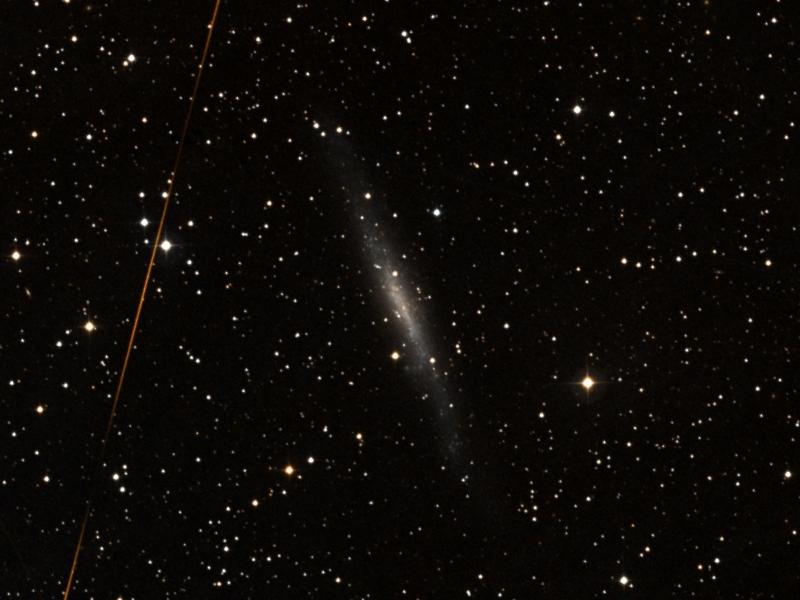
A thin edge-on dwarf of the IC 342 group — a pale needle at 250 mm, our galactic neighbourhood seen through the Camelopardalis veil.Une naine mince par la tranche du groupe d'IC 342 — une aiguille pâle à 250 mm, notre voisinage galactique vu à travers le voile de la Girafe.Una enana delgada de canto del grupo de IC 342 — una aguja pálida a 250 mm, nuestro vecindario galáctico visto a través del velo de la Jirafa.Eine dünne Kantenzwergin der IC-342-Gruppe — eine blasse Nadel bei 250 mm, unsere galaktische Nachbarschaft durch den Schleier der Giraffe gesehen.
large scope, dark skygrand diamètre, ciel noirgran abertura, cielo oscurogroße Öffnung, dunkler HimmelDSS2 — STScI/NASA · CDS
TypeTypeTipoTyp
galaxygalaxiegalaxiaGalaxie
ConstellationConstellationConstelaciónSternbild
Camelopardalis
MagnitudeMagnitudeMagnitudHelligkeit
11.5
SizeTailleTamañoGröße
4.42′ × 3.1′
Surface brightnessBrillance de surfaceBrillo superficialFlächenhelligkeit
23.0 mag/arcsec²
DistanceDistanceDistanciaEntfernung
about 180 million light-yearsenviron 180 millions d'années-lumièreunos 180 millones de años luzetwa 180 Millionen Lichtjahre
One of the most massive spirals known, warped and asymmetric, and the farthest object on the Herschel list — a dim oval at 250 mm in Camelopardalis, nearly two hundred million light-years out.L'une des spirales les plus massives connues, gauchie et asymétrique, et l'objet le plus lointain de la liste Herschel — un ovale discret à 250 mm dans la Girafe, à près de deux cents millions d'années-lumière.Una de las espirales más masivas conocidas, alabeada y asimétrica, y el objeto más lejano de la lista Herschel — un óvalo tenue a 250 mm en la Jirafa, a casi doscientos millones de años luz.Eine der massereichsten bekannten Spiralen, verbogen und asymmetrisch, und das fernste Objekt der Herschel-Liste — ein mattes Oval bei 250 mm in der Giraffe, fast zweihundert Millionen Lichtjahre entfernt.
large scope, dark skygrand diamètre, ciel noirgran abertura, cielo oscurogroße Öffnung, dunkler HimmelDSS2 — STScI/NASA · CDS
TypeTypeTipoTyp
galaxygalaxiegalaxiaGalaxie
ConstellationConstellationConstelaciónSternbild
Draco
MagnitudeMagnitudeMagnitudHelligkeit
11.9
SizeTailleTamañoGröße
4.11′ × 3.55′
Surface brightnessBrillance de surfaceBrillo superficialFlächenhelligkeit
23.5 mag/arcsec²
DistanceDistanceDistanciaEntfernung
about 130 million light-yearsenviron 130 millions d'années-lumièreunos 130 millones de años luzetwa 130 Millionen Lichtjahre
A face-on Seyfert spiral in Draco's far north, circumpolar for most northern observers — a round condensed glow at 250 mm available every month of the year.Une spirale de Seyfert de face dans le grand nord du Dragon, circumpolaire pour la plupart des observateurs boréaux — une lueur ronde et condensée à 250 mm, disponible chaque mois de l'année.Una espiral Seyfert de frente en el extremo norte del Dragón, circumpolar para la mayoría de los observadores boreales — un resplandor redondo y condensado a 250 mm, disponible cada mes del año.Eine Seyfert-Spirale in Draufsicht im hohen Norden des Drachen, zirkumpolar für die meisten nördlichen Beobachter — ein rundes, verdichtetes Glimmen bei 250 mm, in jedem Monat des Jahres verfügbar.
Both stars bright enough for a small telescope, wide enough to split.Deux composantes assez brillantes pour un petit télescope, assez écartées pour être séparées.Ambas componentes lo bastante brillantes para un telescopio pequeño y separables.Beide Komponenten hell genug für ein kleines Teleskop und weit genug zum Trennen.
Sep.Sép.Sep.Abstand
PAAPAPPW
MagsMagsMagsHelligkeiten
12 Lyn
8.8″
309°
5.4 / 7.0
19 Lyn
13.8″
317°
5.8 / 6.7
41 Aur
7.5″
358°
6.2 / 6.9
HD 65448
51.6″
80°
6.2 / 7.5
HD 48766
4.5″
77°
6.3 / 6.3
HD 52859
4.4″
147°
6.9 / 7.0
HD 82685
4.9″
126°
7.0 / 7.2
HD 36146
7.8″
72°
7.5 / 7.5
20 Lyn
15.1″
256°
7.5 / 7.7
HD 57128
31.6″
84°
7.6 / 7.8
HD 31864
32.9″
211°
7.7 / 8.0
HD 61907
14.9″
186°
7.8 / 7.8
Also on this chartAussi sur cette carteTambién en esta cartaEbenfalls auf dieser Karte
2 · Everything else the chart plots, easiest first where a rank exists.Tout le reste de la carte, du plus facile au plus difficile quand un classement existe.Todo lo demás que traza la carta, de lo más fácil a lo más difícil cuando hay clasificación.Alles Übrige auf der Karte, wo möglich nach Schwierigkeit geordnet.
TypeTypeTipoTyp
MagnitudeMagnitudeMagnitudHelligkeit
SizeTailleTamañoGröße
LDN 1466
dark nebulanébuleuse obscurenebulosa oscuraDunkelnebel
23.8406′
NGC 2126
open clusteramas ouvertcúmulo abiertoOffener Sternhaufen